
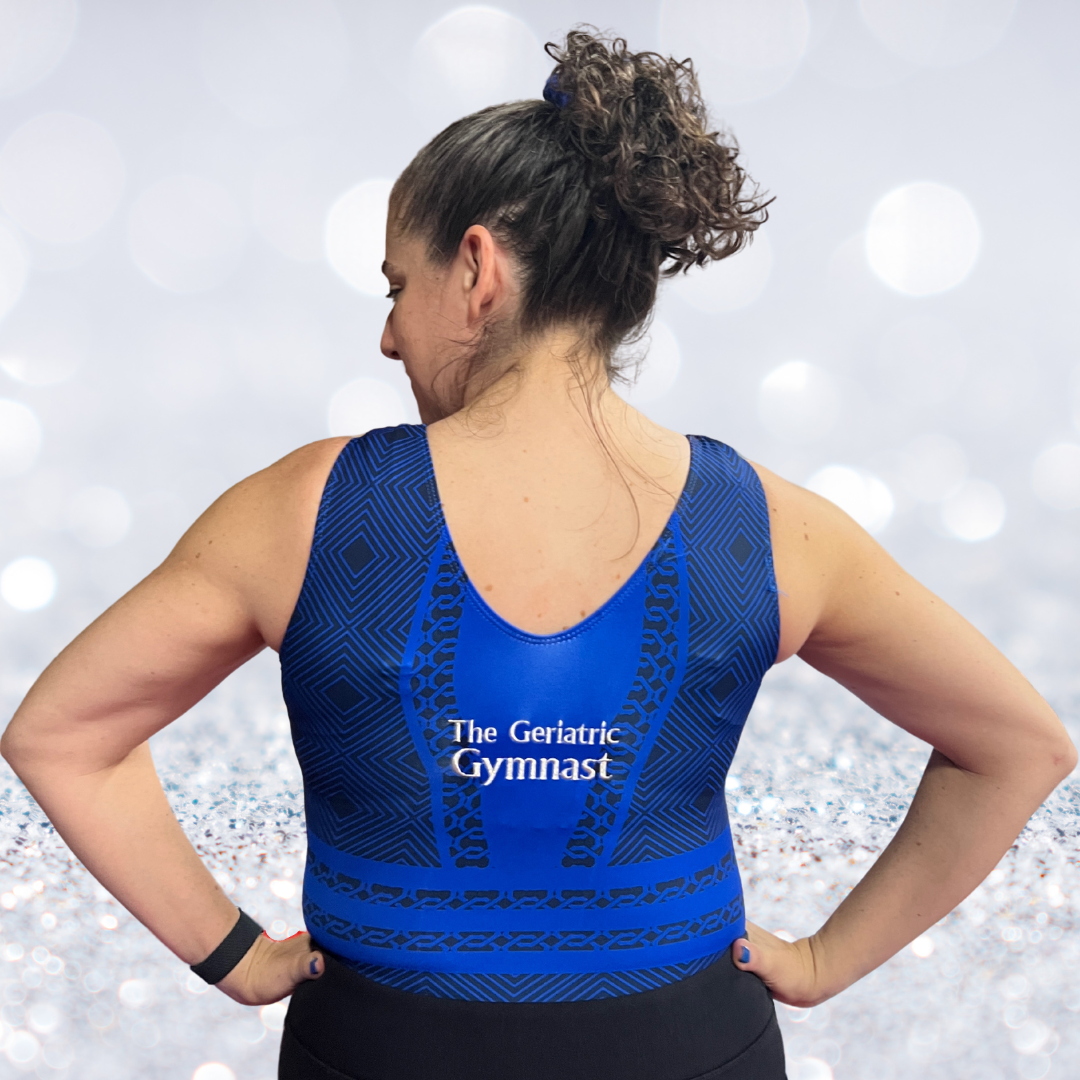
I call myself The Geriatric Gymnast for fun. GG, for short. The name encapsulates the creaky joints, aching muscles and energy struggles that often impede my training as an adult gymnast moving through the menopause transition.

Cheeky monikers aside, I have been laser-focused on bolstering my aging body to avoid frailty in my real geriatric years.

The demands I am making now on my body systems are high.
With every passing day comes a reminder of the need for proper recovery and sleep restoration that increases exponentially every day. Life has also become about staying ahead of the inevitable muscle loss and weight gain that accompanies midlife.
There are more studies coming out every day that support increased protein intake, spending time jumping, stomping and lifting heavy things from thirty and beyond to build our bone and muscle mass. Frailty is a silent killer of women and I will be having none of that, thank you.
Thus, the GG identity reflects the intersection of using my adult gymnastics escapades as a strengthening and stabilizing force through the meno-transition process.
Someday, I’m going to publish this book about how that intersection has played out in real life. It’s in my retirement plan. Stay tuned.

I’m always on the lookout for more studies that present accurate information about women going through the second half of life. What I’ve come to understand is that the choices that we make as we move into our forties and fifties will, without question, directly affect the trajectory of our healthspan.
Healthspan?
The term “healthspan” has risen in ubiquity in the last quarter century. It seems to be replacing “lifespan” in describing the second half of our lives. Basically, we may live until we’re one hundred, but if we aren’t in good health and functional, it’s going to be a pretty miserable existence. Do I want to be hunched over and unable to get out of a chair by myself?
I reply with a hearty, Fuck No.
So, I’m not interested in increasing my lifespan if I am not also increasing the quality of my healthspan.
Building a plan with shared expertise
As someone who tries to plan for the future, at least when it comes to my well-being, I’ve doubled down to ensure that the choices I make will improve my healthspan. Part of that is tuning into the experts in medicine who have dedicated to themselves to focus on medicine and wellness in midlife instead of the hokey “influencers” who say anything to sell crap.
To me, the real experts are the doctors who have struggled through menopause and have focused their practice on the study and dissemination of menopause transition research.
I’ve written lots about how Dr. Mary Claire Haver and Dr. Vonda Wright have been shining beacons throughout my meno-transition process. Reflecting On My Peri Journey and Optimizing Menopause: Personal Health Insights are two of those posts.
Recently, I came across the Substack of Sara Szal MD, another ob/gyn who recently wrote about the gaps in women’s healthcare. She dives into the research papers that our doctors may not be reading. She offers, in great detail, the hows, whys and what to do about its of myriad facets of the process.
In her March 23, 2026 article, she made some major points about how important it is to start hormone therapy earlier than later, how it is associated with a younger biological age, and how protective it is of the systems that keep us well. Waiting too long to address plummeting hormone levels is like putting a bandaid on a gaping wound. It doesn’t address the massive amounts of internal damage that hormone depletion does to our body’s systems over time.
In her March 27, 2026 article, she discusses the importance of staying ahead of the inevitable muscle loss in menopause and looking to grip strength as an indicator of longevity and health span.
For me, these are not new concepts. Like I said, I’ve been informing myself for years about the information shift in women’s health. But for many, the information I now take for granted is news to them.
Learning from communal experience
Another expert that I recently learned about was one of Dr. Haver’s unPAUSED podcast guests. Dr. Hillary McBride is a research psychologist who has not yet reached the menopause transition, but her doctoral dissertation is called Menopause as Metamorphosis: The Meaning and Experience for Women of Doing Well During the Menopausal Transition (2019).
I’d say she’s done plenty of homework and preparation for when her time comes. She has a lot of good perspective to offer regarding how we perceive the meno-transition.
For her dissertation, she interviewed ten post-menopausal women about “doing well” during their menopause transition. She discovered several themes through those interviews:
- a sense of menopause as a physical non-event
- the importance of relationships and dialogue with other women
- a sense of freedom
- a sense of transitioning to another phase of life
- menopause as metamorphosis
Save for the menopause as a “non-event” (it’s definitely eventful for most), these themes were inspiring to me. One of the things she discussed in Dr. Haver’s podcast that stuck with me was the importance of tapping into our community to empower us understand our own experience. Women tend to share out the information that works for them freely so that we all can benefit from that wisdom.
Support from a like-minded community who are going through similar experience provides a great deal of personal validation. Through the intersection of my Geriatric Gymnast and meno-transition, I’ve come across many women in their forties through sixties with whom I share similar life experiences.
I think this is part of why I have come to love blogging about midlife. I know a lot of women in many different stages of adulthood. Many have not yet reached the middle portion of their lives. I also know that there are women who haven’t yet done this kind of deep diving into the strategies that can help them feel better in midlife.
Because of the information I’ve had access to in order to formulate my healthspan plan, I am feeling much better in my own body. Because of that access, I have been able to minimize the negative impact of my transition. Maybe not to the degree of a “non-event,” but enough that I’m living a better-than-functional life with my whole existence. I’m working to set myself up so that the quality of my second half is second to none.
That is largely due to the informational generosity of others who are a step or two ahead of me. For that, I am grateful.
The metamorphosis of the meno-transition gives us the opportunity to discover a new universe of self to be explored. We deserve the freedom of thriving in our butterfly era. If my experience can encourage someone else to start their own diving expedition for the best midlife strategies, I’m happy to share the details of mine. There’s no need to gatekeep information that affects 51% of humanity.
When women feel better, they do better. That makes the world better.
Read more of my meno-transition posts in the Mid-Life Musings section of my website. If you're somewhere in your transformation to your butterfly era, you might find some useful information!


What did you think?