

Time heals all wounds. As I approach the five month mark in my Achilles recovery, I am happy report many more skills that have been added to my movement rotation. This post reflects on balancing the equation between safety and progress.
May 18, 2025

As fast as my recovery may seem to the outsider, it has felt like I’ve been injured for an eternity.
From the beginning, my recovery priority was to minimize time spent being laid up. The focus has been to do the essential work for strong healing from day one. In my now-expert opinion, the catalyst for the speed of healing is about being proactive and productive in the recovery work. To heal, you must create the environment for building and maintaining progress, every single day.
The environment for progress
To do that, you must commit to doing work that is uncomfortable, time-consuming, and frankly, a little scary at times.
For example, since the first week in the cast, ankle movement, no matter how small, has been incorporated regularly into my daily routine. Even now, while sitting and typing or binge-watching a show, when I find myself in stillness, my foot starts moving. In every direction possible.
Early on in my recovery, when I was mostly sitting on the couch, I had plenty of time to wiggle my toes, do small micro-movements at the ankle, and work on strength training for the rest of my body. I wanted to keep my muscles activating and minimize the amount of neuromuscular atrophy that was happening.
As I progressed from the cast to the boot and into regular shoes, the work was adapted to each stage of healing. The therapeutic exercises weren’t comfortable; some were outright painful. The goal was to maintain the right pain to progress balance. Moving forward safely is my focus in this process.
The trouble with rest
Too much rest and stillness invites a disturbing stiffness in the healing tissues all around my ankle. That’s a normal thing in general for someone in their 50s, but this injury really highlights the Frankenstein’s monster walking cadence I’ve been experiencing. When I stand up after even five minutes of complete rest, I start walking like an 90-year-old until the tissues soften up again.
Fortunately, I have been walking much more smoothly this month. Limping is mostly limited to the time after rest periods. Like all of my other joints, resting makes everything stiff, especially the Achilles. I still have to be mindful to maintain proper walking technique as I continue to retrain my brain to walk normally. But, once my ankle is warm and I’ve been moving around for a while, the odd sensations that lead to limping fade away. At least temporarily, until I rest again.
Balancing the equation
Since the beginning, there’s been a large part of me that hasn’t fully accepted the long-term magnitude of this injury. I’m an active, busy person who doesn’t suffer setbacks well. I just want to keep going and doing.
That said, the constant refrain of “I have too much to do in this life” has necessitated my wise mind to take over. So, my decision-making post-injury has been informed by the balance of two things:
- My endgame is to make my way back to normal to live my life the way I want.
- I must, at all costs, avoid a re-rupture so I don’t further interfere with my endgame.
My recovery plans have all been intertwined in those two factors of the recovery equation.
Bypassing obstacles
In my 50+ years, I have learned to get things done despite big obstacles. The Achilles rupture has been a giant one, but it’s not Mount Everest. It’s more like one of those super high climbing walls that you have to keep training on through exhaustion before you get good at it.
Whether injured or not, I’ve navigated my life to be as independent as possible. I see an obstacle that gives me pause and I go through the mental machinations of “how am I going to do this anyway?” It’s a problem to solve, not a wall that stops me.
Since going back to the gym, I have been analyzing the ins and outs of each apparatus and how to safely bring them back into my practice. Every session provides an opportunity to gradually test the strength of the repair. I prioritize good technique and make sure my body is actually prepared to take on a skill.
Employing extra support
In month five, I felt more comfortable pushing the envelope, but with some extra support applied.
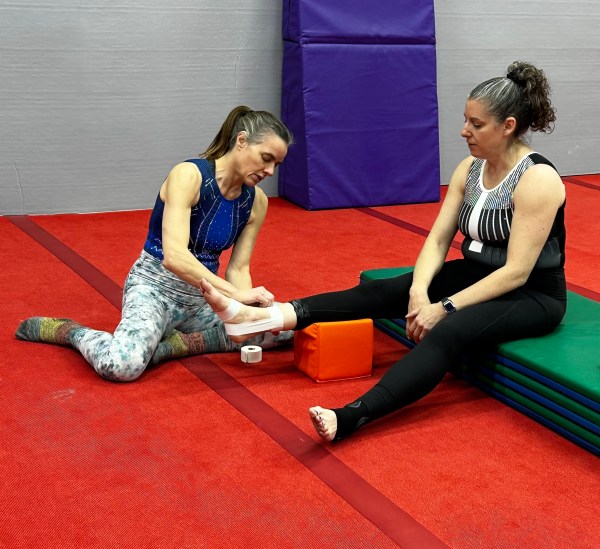
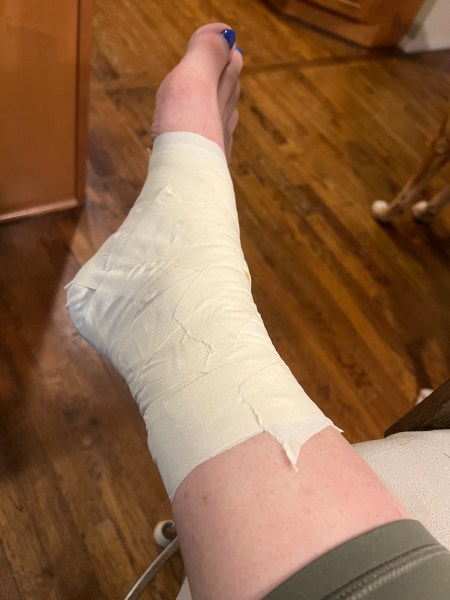
For protection, I had Tammy tape my ankle to prevent excessive loaded dorsiflexion as I tried some of my former skills. While I don’t love the feeling of tape, it is definitely helpful to support the joint.
Eventually, I figured out how to tape myself. First time was a little tight, but it got the job done.
The catalyst for the speed of healing is about being
proactive and productive in the recovery work.
To heal, you must create the environment for
building and maintaining progress, every single day.
Getting back to business
All of the work I’ve done has strengthened me to the point where I can test some higher-level skills. I’ve had to navigate obstacles by creating work-around solutions that are safe.
This is what I’ve brought back into the regular rotation this month:
Floor: Handstands and Cartwheels
OBSTACLE ➡️ The push-off and the landing
I spent weeks thinking about push-offs and landings. I haven’t had enough strength to do a proper toe push-off from the injured side. I was also concerned that a regular toe-ball-heel landing would create too much force on the tendon.
Solution/work-around
Several weeks ago, I started trying a handstand by pushing off on the injured side. I kept it flat-footed, which meant I had to give extra push from the back kick leg in order to get fully inverted. It’s a little awkward, but the result is training my gluteal muscles to work a little harder, which is beneficial. I kept my foot flexed for a flat-foot landing. It felt a little clunky, but it was safe.
My friend Lisette suggested a side entry handstand: basically a cartwheel start off the good side and handstand kick-down to the injured side. It worked. From there, it was about continuing the arc and land flat-footed at the and of the cartwheel. The transition was pretty smooth, and suddenly, my cartwheels returned.
The video shows that process.
A week later, I progressed to pushing off my right foot. It was just a matter of time before I was confident enough to try it.
Trampoline: Flips and Combinations
OBSTACLE ➡️ Fear of too much loading during repeated rebounding
Ah, my beloved trampoline. It’s the place where I get the most joy and in the early months of the injury, I had to stay away from it. Too much loading too early can lead to re-rupture, so there’s a lot of fear and caution associated with getting back to bouncing.
Solution/Workaround
At week 10, I started to ease my way back to the trampoline with gentle rebounding. Fortunately, it is a very absorbent surface. Each week, I gradually built in intensity and duration to challenge the repair and rebuild neuromuscular patterns. If I felt any discomfort or strain, I stopped bouncing.
Once I started to bring flips back in the mix, I felt more comfortable with some ankle support. I found some compressive ankle sleeves that I found at Walgreens . These felt adequate for front tucks, where the foot position on the landing is more plantar-flexed. My physical therapist suggested that I wear them on both ankles, so the sensation of compression on the skin would feel more even. This apparently plays an important feedback role for your brain.
Once I decided to try a back tuck, taping would be required. If I under-rotated and landed with my feet behind my hips, it could invite a potential disaster. The tape limits the amount of dorsiflexion that can happen on a landing, which feels a little safer. Fortunately, it worked very well. I was able to focus on proper technique without being overly concerned about the tendon. After a few sessions of doing back tucks in the belt, I was ready to go solo.
Once the individual flips felt solid, it was time to start building more combinations. This is what I have missed the most being sidelined. The blending of creativity, physical challenge and overcoming fear has always resonated with me. Finally, I’m able to start playing again.
A week later, I added front handsprings and a longer combination starting with a twisting backdrop.
It’s so encouraging to feel the progress each week. Every new bounce feels stronger and more confident. My heart is happy. 😃
Bars: Pullovers and Back Hip Circles
OBSTACLE ➡️ Not enough push strength
Ah, bars. Not my favorite apparatus. I am woefully lacking in this department, for many reasons. The only skills I can do (sometimes) are pullovers, back hip circles and the occasional mill circle. With my push-off foot being weaker than normal, the pullovers are a much greater task.
Solution/Workaround
If I’m being honest, I’m less motivated to do the work to excel on bars. It’s not as much fun and the requisite strength is much harder to attain than anywhere else.
That said, bars is more about upper body strength than ankle strength. To that end, my solution during recovery has been to give my push and pull strength more attention.
Working on rings has also helped to build better grip, lat and core strength, which are necessary for bars. I try to do longer isometric holds to maximize muscle building.
Whenever I do take a turn on the bars, I’ll try a few sets of 2-3 repetitions, whether I get around or not. I believe it’s the fight to get over the bar that defines the progress. Like the video suggests, every turn I take feels just like starting over.
For me, bars is an eternal, non-linear work-in-progress.
When we sustain big injuries, the forced movement hiatus creates a necessary downshift in our brain-body connections. It can feel really scary, like we’ll never be able to return to our former selves. With careful, smart planning and execution of each phase of recovery, we can make a strong comeback.
The end result may or may not look exactly the same as before, but progress is a direct result of the effort we put into our recovery. Our self-care solutions must reflect a commitment to doing that hard work every day. In the end, our future selves will be grateful that we made that commitment to making our lives easier.
Want the whole story from the beginning?
Read Sometimes You Break Yourself…Again.

 Stacey's Headspace
Looking great.It’s amazing how much you’ve accomplished. You never quit.
Iris
LikeLiked by 1 person