

It’s been over 3 months since my Achilles tendon rupture. This is a reflection on the quest to balance fear and progress through long-term injury recovery.
March 26, 2025
Not too long ago, all of my posts were about the progress I was making at the gym. I’ve celebrated the baby steps and the big leaps. What new surface was I flipping on? What cool new trampoline combination could I make up? How can I overcome this nagging fear?
Things change in a split-second
In December 2024, my social media posts changed dramatically.
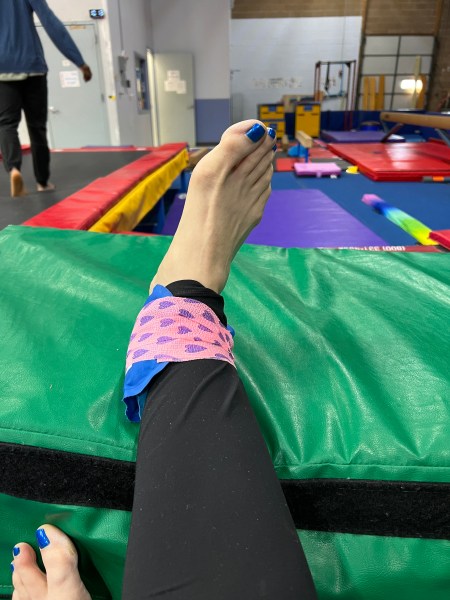
My flippy gym activity came to a screeching halt when my Achilles tendon popped on a back handspring landing.
Ouch. That hurt my soul as much as it did my ankle.
It’s one thing if you twist your ankle because your angle was off or you tripped on something because you weren’t paying attention. Accidents do happen, especially if you aren’t mindful. But this time, I was completely mindful and aligned. My body completely failed me. It didn’t matter how strong or flexible I was or how good my technique was. The darned tendon just snapped.
The moment I realized what happened, my mental universe was rocked.
In that split-second, I was forced to go into emergency fix-it mode. There was a flurry of visits to the ER, doctor’s offices and finally the hospital. All of my mental energy went into putting my tendon back together.
Then the long recovery began. Part of that recovery was coming to terms with my joyous flipping being put on the back burner. Heck, walking was temporarily put there too. Every aspect of my entire life had to be re-defined and managed very differently.

I graduated from cast to boot to sneakers fairly quickly.
Of course, time and work heals injuries. I defied many of the odds, staying ahead of the timeline curve for this injury. I even returned to the gym and started bouncing a little on the trampoline. I needed to remind myself that I was down, but not out.
This affects who I am
I am a 53-year-old woman in perimenopause. I’ve been educating myself about this time in my life, fighting the decline that many middle-aged women suffer.
I embrace my age, but not the body breakdown that happens when estrogen disappears. I’ve figured out an effective balance between nutrition, exercise, rest and hormones and I’ve been feeling pretty good. I’ve been living the life I want, being who I want to be.
Building strength is part of who I want to be.

Suffering a big injury really gets in the way of living your best life. It also messes with your head. If it prevents me from living my life the way I want, what does that mean for my future self? Who is she going to be?
Our self-concept
We tend to wrap our identities around the things we do and the people we associate with. In my case, a large portion of how I see myself is embodied in my physical ability. I am a dance teacher. I am an adult gymnast. I love hiking with my husband. I can do things that many people (especially my age) can’t. These abilities have been cultivated over time through lots of mental and physical effort. Doing them makes me happy and proud of myself.
Now that this injury has become the forefront of my existence, I am processing many questions. What will my future limitations be? What changes about me if I can’t do my favorite activities? How close can I get to the former version of myself? How long will it take? Will it ever actually happen?
Surrounding all of these questions is the reality of my age. I know that age makes things more difficult in general. That’s why I have worked so hard to mitigate the natural decline of getting older. I’m not ready to give up on physical progress and building strength. It’s just that in this moment, I have to focus on getting my body to a “normal” state of being.
The physical issues of getting back to normal
Regarding my Achilles recovery, I think I’m feeling in a bit of a limbo phase right now. At the 3-month mark, I sense a plateauing in progress. I’m still moving forward, but each next step feels harder to attain.
Walking
I’ve been advised by my physical therapist to work to eliminate the limp in my stride. Walk slower and take small steps. Easier said than done.
My “normal” walk usually equates to fast, long strides. When I walk down a school hallway, I feel the strain in my foot and ankle. Walking without a limp feels nearly impossible. My brain feels compelled to compensate for the inevitable stiffness and weakness I feel in my ankle and foot. That means a slight limp naturally happens.
When I take shorter, slower steps, I don’t need to limp. But who has the patience to take small, slow steps? When I have to get somewhere, fast is my natural default.
These are a few more complications to attaining a smooth walking pattern:
- Every time I stop moving for more than five minutes, the tendon stiffness increases exponentially. I have to warm up my tendon all over again every time I stand up. Or, I have to keep moving my foot in every direction, all the time. No rest for the weary.
- The site of the surgical incision still gets very sore, especially when I wear sneakers.
- If I’m active on my feet for too long, the ankle swells.
- I also still have some partial numbness in my heel. That’s fun.
- Whenever I start pushing through my toes, I feel the shin and outer tendons of the ankle acting up. I also feel considerable weakness in the underside of the foot.
Yes, I’m dealing with all of these things at any given time. The physical feelings while walking are all over the place and not comfortable. It reminds me how far I have to go to build strength and endurance for proper walking.
Single heel raises
Unassisted single heel raises are my Mount Everest. At this time, they feel impossible to do. I always need to hold on to something and push or pull some of my body weight. Each week, my physical therapist keeps asking me how they’re going. Each week that passes, they are still really hard.
Every time I try them, there is a painful pull at the back of the ankle. My toes and feet don’t have enough strength to overcome gravity by themselves. It’s like my body keeps signaling to stop, even though I’m supposed to do it anyway. It’s maddening.
I’m just starting to climb the stairs on my forefoot, rather than placing my whole foot on the step. It’s a step in the right direction, I suppose.
I’m also doing a lot of eccentric heel lowering exercises. This encourages my brain to take more weight on the foot and ankle.
Range of Motion
Interestingly, my ankle dorsiflexion on my injured side is now about 5 degrees better than on my non-injured side. But, putting my body weight into that stretch is still really painful.

One of my exercises is the stretch where your heel drops off the edge of a step.
I cannot yet put my full weight into that stretch. It just hurts too much. The next phase is to push into my toes and raise my heel to neutral. I still need a lot of assistance to do this. Compared to my good ankle, I have a very long way to go.
Mentally managing the reality of this injury
My physical therapist has been very impressed by my determination to heal. He tells me to be patient, that this injury takes a very long time to heal. All of the weakness and incision site pain will last for many months.
The hardest thing to hear from him is that my tendon will never be as strong as it once was. That’s a pretty big statement and it begs a few questions:
- How much strength can I actually build from here?
- How do I know when I can try progressing to the next step?
- How will I know if something is too much?
The mental machinations we deal with in this recovery is enough to make your head spin. There are no clear answers to the questions. It always feels like the safest thing would be to just stop trying to get back to our former activities. But, I’m not ready to give up my flippy lifestyle. Just like I came back after breaking my foot, I have every intention to inch my way back.
Accompanying the above questions, these are some of the layers of concern I’m dealing with:
Limited PT sessions
At some point, I’m sure my insurance company will stop covering my physical therapy sessions. I’ll be on my own to figure out how to proceed with more sport-specific activities.
On top of that, my current therapist has no experience working with gymnasts. He doesn’t know the parameters of the different working surfaces or how the impact on each might affect the injury. My forward movement there will be based upon my ankle’s tolerance of slowly increasing forces at different angles. Scary.
Fear of re-rupture
The fear of the risk of re-rupture has been instilled boldly in my brain. With every step forward that I take, the fear of that is in full force. Even when I was healing from a broken foot, I wasn’t quite this anxious.
As fast as my recovery has seemed to others, I’m not a miracle case. I’ve proceeded with great mindfulness, based on how I feel and what the medical professionals gave clearance for. All of it has all been done through some trepidation. With each step forward, I’m always worried that it might be the step too far.
Fear of losing who I want to be
There’s another fear that I am trying to manage. I do not want to give up the active and athletic part of my identity. Many elite athletes end their athletic careers with these kinds of injuries. I am far from elite, but the anticipatory anxiety surrounding the loss of activity is the same.
There is definitely a mental toll to acknowledge when you are enduring long-term recovery.
With all of the fears and concerns said out loud, my determination to make a full recovery remains constant. I am resolved to keep walking the line, and staying a step or two ahead of the curve. I have no interest in setting myself back any further by doing too much, too soon. I also have no interest in letting fear get in my way of living my life on my own terms.
How I manage the mental stress of recovery
How do I deal with the stress? By taking things one day at a time. Everyday, I face each challenge head on and take them on from one moment to the next. I acknowledge both how hard things are and how much healing has happened already. My favorite mantra is “Progress is not linear.” This reminds me to give myself grace and keep my eyes on the horizon.
In 3 months, I’ve had some curve-busting progress. I am bound to have moments of setbacks. In those moments, I only look back to see just how far I’ve come. Then, I dig in and push further through the discomfort.
In the end, who I am lies in my resolve to keep moving forward.


 Stacey's Headspace
Stacey: I know how difficult it can be to come back from a severe injury. Been there, done that. You’re young, physically fit, and will definitely get back to the activities you love. I have no doubts.Sent from my Verizon, Samsung Galaxy smartphone
LikeLiked by 1 person