

At six weeks post-surgery, my recovery is going very well. When I compare my progress to some of the published protocols, I’ve been slightly ahead of the curve. That begs the question, am I progressing too fast? Am I risking re-rupture down the line?
January 29, 2025
Read about my Achilles tendon story from the beginning in Sometimes, You Break Yourself...Again.
Progress at week six
Six weeks after my surgery, here’s what I can do:

- Walk around the house and climb stairs completely bootless (bare feet and slippers).
- Walk the hallways at work, slowly, without the boot. I still teach and coach with the boot on.
- Drive with no discomfort.
- Double heel and toe raises with a slight favoring of my good leg.
- Step ups on the injured side and holding for a few seconds.
- Stand on a 2″ foam pad with my injured bare foot. It’s not comfortable, but I can do it.
- Walk forward and backward slowly with minimal discomfort.
- With my injured side toe touching the wall, I can touch the same side knee to the wall with minimal discomfort.
There has been a lot of great progress. I’m proud of the work I’ve done and thankful that my body has taken well to the healing process. That said, I’ve wondered if I’m going too fast, too slow, or just right. Recovering safely is my mission.
Conservative vs progressive mindset
I am typically a very conservative person with regard to personal risk. And yet, I am an adult gymnast. The fact that I got this injury in the gym is not lost on me.
To be fair, most Achilles tendon ruptures in my age group are from playing an aggressive game of pickleball. Apparently, pickleball has caused a rising epidemic of Achilles tendon injuries, particularly in the over 50 set. That was probably the first thought my doctor had when I walked in the door. I’m certain he wasn’t expecting to hear it was a round-off back handspring landing that did it. And I’m sure he didn’t expect to see a video of it that day. But I digress…
Rehabilitation protocols
The matter of rehabilitation protocols and timelines has been swirling in my head for weeks now. Knowing what is too much or too little in your rehab efforts is confusing.
Of course I want to heal as fast as possible. And, I am well aware of the 6-9 (12?) month return-to-sport timeline that I keep seeing on the protocols. My conservative nature does not want to rush this recovery. My progressive nature wants to be active and efficient in my rehabilitation efforts. Every day, I want to see more progress, even if it’s with baby steps.
After surgery, the doctor puts you in a cast and crutches and sends you away. You put your foot up, stay off of it, and go through your first few weeks of healing. They don’t include a chart with all of the stages of rehab. When you get the boot, they give you very little information. If you’re lucky you’ll start physical therapy shortly thereafter.
If you want to do a deep dive into the rehabilitation process, you have to look the information up yourself. I looked up several and landed on this one from Dr. Benedict Nwachukwu at Hospital for Special Surgery in New York City. Looking back, my doctor’s philosophy seems to track with Dr. Nwachukwu’s.
So, it seems I’ve been following a more progressive rehab timeline, bearing weight and working mobility sooner thank later. That’s fine by me.
Social media confusion
Of course, I’m proud of my progress. I like to share that in the communities with whom I have shared interests. Specifically, adult gymnasts and fellow Achilles tendon recoverees.
I’ve been posting my rehab progress on my social media accounts and groups.
Typically, the response is supportive.
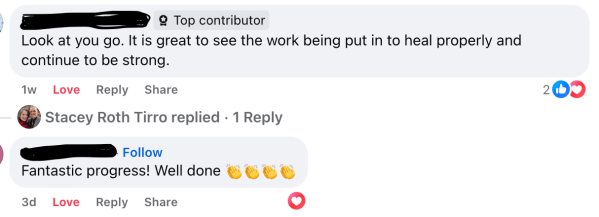
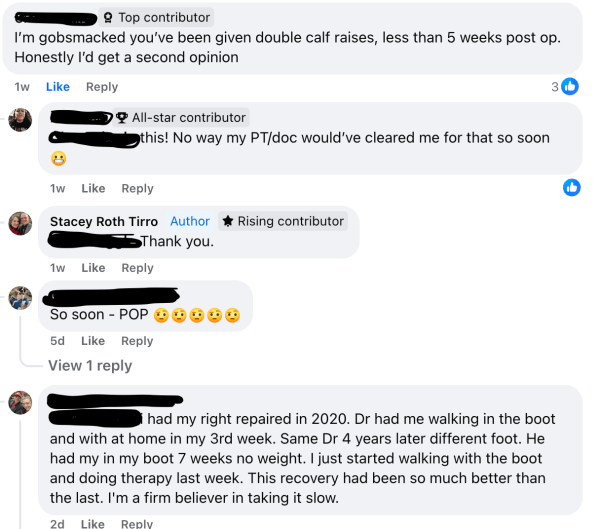
Sometimes, the comments are less supportive. It gets confusing, to be sure.
So, when my physical therapist moves me to a new exercise, I ask again and again if it’s okay. There’s definitely discomfort (and some pain) involved in PT. But, the last thing I want is to go back to square one because of a re-rupture.
That said, physical therapy is not supposed to be a walk in the park. Right now, I am literally retraining my ankle, foot and brain to learn how to walk again. It’s a mental and physical battle.
Validation through science
On one of the social media sites, someone mentioned an Instagram page called @achilles.rebuild. The page is owned by Dr. Chris Smith, a board-certified physical therapist with a bunch of other certifications to his name. His posts are very interesting and informative. He offers many different Achilles-building exercises to do at different phases in the healing/strengthening process. He also offers 1:1 online coaching for Achilles rehab.
What really caught my attention was one of his recent posts. He highlighted a 2022 study all about Achilles recovery. It’s called Rehabilitation following operative treatment of acute Achilles tendon ruptures: a systematic review and meta-analysis. I looked it up and started reading.
There, in the abstract, I read this:
Early functional rehabilitation protocols with early ankle mobility and weight bearing following surgical repair of acute Achilles tendon ruptures are safe and they apparently allow for a quicker return to work and return to sport and seem to lead to favourable results.
Really. There it was: validation in black and white. I was intrigued to learn more about the details.
A closer look at their analysis
The researchers screened 2760 studies and found that 20 randomized controlled trials with 1007 patients were eligible for the review. They were looking to compare treatment outcomes following Achilles rupture surgery. The outcomes included:
- re-rupture rates
- complication rates
- functional outcomes
- return to work and sport
In their analysis, they grouped participants according to their post-surgical mobility and weight-bearing allowances within the first four weeks post-surgery.
The groupings were as follows:
- Group 1: Weight bearing and Mobilization (most progressive)
- Group 2: Weight bearing and Immobilization
- Group 3: Non-weight bearing and Mobilization
- Group 4: Non-weight bearing and Immobilization (most conservative)
These were their conclusions:
- Group 1 (weight bearing/mobilization) had the lowest prevalence for a re-rupture, a major or minor complication.
- Group 4 (non-weight/immobile) had the poorest results for return to work and return to sport.
- Overall, accelerated functional rehabilitation protocols following surgery can be considered safe.
The authors of the study also noted that based on another meta-analysis by McCormack and Bovard, “more aggressive rehabilitation appears to have a beneficial effect on return to work and return to sport.”
If I were a participant in the study, I’d fall into group one: weight bearing and mobilization within the first four weeks after surgery. After two weeks in the cast, I was given a walking boot. I was encouraged to slowly increase weight bearing and approved for physical therapy. Two days after I got the boot, my crutches were gone. Whenever I took the boot off, I worked on moving my ankle in every direction. I’ve been progressing every day since.
Validation indeed. If I had any initial doubts about the speed of my progress, they are now gone.
My conclusions
The validation from this study does not mean that I’m going to start running tomorrow. Even with an progressive timeline, this recovery is still very long and must be carefully executed.
That said, I think I won’t be as afraid to work on the less comfortable exercises. If my physical therapist says it’s time to progress, I will gladly comply. I will continue to replicate my exercises at home, at work, and at the gym.
While I don’t have specific goals related to returning to my beloved trampoline, I feel confident that it will happen. Sooner or later.
For the moment, my goal is to walk comfortably. That’s a good first step.
Keep up with my recovery, my gymnastics habit, and all things mid-life. Subscribe below to the blog to get up-to-date notifications whenever I publish something new!
RESOURCES
Achilles Tendon Repair Rehab Protocol
The Achilles’ Heel of Pickleball: Sharp Rise in Tendon Injuries (2024)

 Stacey's Headspace
Informative as usual. You’ve come a long way.
Iris
LikeLiked by 1 person