
Attention: perimenopausal warriors. Feeling the waistline expand? Yeah, me too. This is the yearly overview of my personal experience that includes helpful resources and health-management strategies.
My last weight-loss post was a year ago. Sometimes, I feel like I’m fighting a losing battle. I think it’s safe to say that this year hasn’t really been about weight loss. Rather, the theme has been about trying to mitigate the damage of the perimenopausal waistline creep.
As always, I like to reflect back over the year to see what has been happening with my body. Here we go…
2024 by the numbers
Full-disclosure, I don’t like these numbers.

| January | 175.1 |
| February | 176.8 |
| March | 175.7 |
| April | 177.4 |
| May | 178.1 |
| June | 178.3 |
| July | 180.2 |
| August | 180.7 |
| September | 182.6 |
| October | 181.9 |
| November | 181.4 |
| December | 182 |
Yeesh. This progression is what I’ve been afraid of moving into this time of my mid-life. The slow upward creep is what my nutritionist and endocrinologist have been warning me about for years. It’s now happening. I don’t like it one bit.
And it’s all related to perimenopause.
Perimenopause: What am I doing about it?
Perimenopause (my definition):
the period of 7-10 years before your final menstrual cycle
where your hormones wildly fluctuate,
sending you into a physical and mental tailspin.
Here’s a great Perimenopause 101 blog by Dr. Mary Claire Haver that offers some myths and facts about peri basics.
I have had to acknowledge and come to terms with the reality of this chapter in my life. I have no idea when it actually started, but I know I’m in the thick of it. Here’s my current reality:
The bad news
The dreaded, squishy peri belly has definitely invaded my personal space. Though my arms and legs are muscular and slim, the belly definitely betrays my age. I feel like my mid-section resembles those of the older women in my family that I remember as a kid.
Along with the unwelcome, insidious waistline expansion, I was dealing with a whole bunch of new, unpleasant symptoms. They crept in slowly and when I started to notice them, it freaked me out.
The good news
Health-wise, I can check off all the good boxes.
- My last bloodwork and cholesterol check was fantastic.
- My bone density is off the charts.
- I am strong as an ox. I can pick up pretty much any heavy thing that I need to pick up. 12 foot ladder? I got that. Overflowing laundry basket? What else you got? Grocery bags? Three on each arm. Under the squish are abs of steel.
- Despite the growing musculoskeletal aches and pains, my mobility is good. I can get to the floor and back up again with no hands, no problem.
- Of course, this is now a little mucked up since I ruptured my Achilles tendon at the gym two weeks ago. This new obstacle complicates things, but I digress…
The other good news is that recently, there has been a groundswell of menopausal support. Doctors who are now “in the know” have been sharing their wisdom with us. Following their counsel has been my first step in managing my own existence.
1. Doing the research
I have done significant research into this huge change in my life. Perimenopause is not so much a milestone as it is a temporal shift in the timeline of life. If I didn’t do my research and take significant action, I’d be writing a very different, more depressing article.
Two books in particular that changed my life (for the better) were Dr. Mary Claire Haver’s The New Menopause and Estrogen Matters by Dr. Avrum Bluming and Carol Tavris, PhD.
These doctors (and many others) are rewriting the narrative regarding menopause care. In response, I have written several blog posts reflecting what I’ve learned. Every woman deserves to know about where these changes are coming from and how it might affect them. Throughout this article, I’ve linked many resources that I’ve used and written about for you to review.
The second step of following the experts’ counsel was making the decision to try HRT.
2. Embracing HRT
HRT = Hormone Replacement Therapy.
When our bodies are in our child-bearing years, the cyclical release of hormones happens naturally. As we move towards menopause, those levels start fluctuating erratically. That’s when symptoms start and some of us need a little (a lot of) assistance. That’s where HRT comes in.
Over the last two decades, women have been made to fear HRT, for no good reason. For more perspective on that, read my last post, Estrogen Matters to your Mind.
In short: the reasons for fear and avoidance of replacing the natural hormones that are slowly disappearing has been debunked. Because of this, I have come to embrace the benefits of HRT.
In June, I started taking Evamist, a transdermal estradiol spray that replaces waning estrogen in my body. Two sprays on my inner arm has been the greatest weapon against my perimenopausal symptoms.
In November, I also started on progesterone supplementation during the last two weeks of my cycle. The research recommends that people who still have a uterus, and are taking estrogen, should also take progesterone. It balances out estrogen’s effects on the endometrium and has a protective effect against endometrial cancer. (RUPA Health, 2024)
These are some other things that progesterone may help to improve:
- Vasomotor symptoms (hot flush stuff)
- Sleep disturbance and quality
- Mood swings and anxiety
- Bone health support
In all honesty, I feel like a different person now. A much better version of my mid-life self. Much closer to myself 10-15 years ago, without the young children to care for. For me, HRT has been a godsend. It has been an important addition to my overall lifestyle and health strategies toolbox.
Since I have been feeling more like my “normal” self, I have been able to accomplish more at the gym.
3. Making Exercise Gains
The only thing that is still hard to manage is the stubborn pooch. It won’t respond easily to anything I’m doing right. Yes, that is the annoying reality.
Nevertheless, I am proud of what I have been able to accomplish this year. Six months ago, I was extremely achy and felt my joints and muscles all the time. My feet hurt. My hips hurt. Everything just hurt.
Since I’ve started HRT, I’ve seen much more physical success because the musculo-skeletal issues are now largely out of the way. My body continues to become stronger and more agile. Most notably, I have overcome some serious Lizard Brain stuff, and have taken more command of my skill acquisition. Under that bit of belly squish is a tank.
Over the last six months, I have amped up my exercise regimen.
Strength training
I’m now lifting more weight than ever before. Unquestionably, there is more muscle that’s increasing the number on the scale. I’m able to do a farmer’s carry with 60 lb weights in each hand for about a minute. I can shoulder press and bicep curl 30 lbs in each hand at least ten times. I can deadlift 225 lbs. That’s more than I weigh, by a lot.
Gymnastics
Since starting HRT, I have made significant improvements in my skills at the gym. I think that because my body has felt much better, I’ve been able to build more muscle. That supports my shoulders and hips, which have been historically wonky. When the body is strong and mobile, the skills come more easily and Lizard Brain gets quieter.
I’m finally chucking those back handsprings on the TumblTrak again. I’ve made the roundoff-back handspring-back tuck combination a regular trampoline warm-up. These were skills that I’d had years ago that I never thought I’d get back. I’m also regularly working towards a real pull-up. It’s still in the future, but I’m getting there.
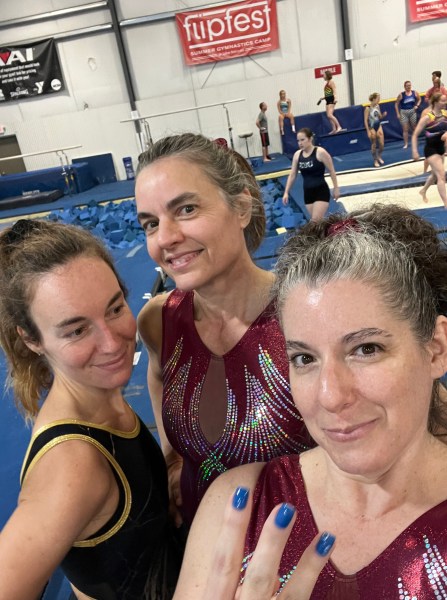
A great milestone that really highlighted my HRT success was a trip to my first adult gymnastics camp this summer.
With my adult gym rat buddies, we spent three days flipping and inverting on all-new equipment. I made it through the collective 12 hours of training that weekend. I bravely tried new skills. I felt a joy that was immeasurable. Even better, I wasn’t even that sore.
Teaching and Coaching
Through all this, I was teaching 3-4 dance classes a day and taking/coaching 2-3 adult gymnastics classes a week. I can demonstrate everything that I need to. I must warm up more now than ever before, but when I do, the sky’s the limit.
Well, maybe not the sky. At some point, I do hit a wall and I need to shut things down. But, that is now part of my wisdom. In turn, I teach my students (adolescents and adults) to listen to their bodies. That’s what we need to do to be safe. That’s what keeps us coming back each class.
In order to keep all of that muscle going strong, I have to feed my body properly. That’s where the nutritionist comes in.
4. Monthly nutritionist check-ins
Supporting all of these efforts is the assist from my trusty nutritionist. I see her once a month to discuss my food needs and habits. It keeps me honest, even when I have a bad food week. She is a great resource for any weird questions I have. (Is flax seed considered a fat? Technically, no.)
To maintain the lifestyle I lead, I must supply my body with adequate protein, fiber, carbs, fat and hydration. This establishes the proper equilibrium so I don’t crash and burn. The monthly check-ins keep me on track.
Her counsel is always stored in the background of my mind, informing every food decision I make. If I eat something “less nutritious,” it is a mindful choice. My next food choice is usually a “healthier” one.
This is the section of my website that covers my discoveries about nutrition.
5. Writing about the experience
I have written a bunch about my perimenopause experience. My energy, mood and overall feeling of health had been slowly tanking over the past few years. It had gotten to the point where I needed to educate myself on a grand scale. I had to figure out how to manage symptoms and take back the control over my well-being.
Taking in all of that new information is a lot. Once of the ways I process it is by writing and sharing it out. That action generally sparks conversations with people who are in the same space as I am.
When we are properly informed about what is going on in our lives, we are empowered to take control. Then, if something goes awry, we can tackle it with wisdom instead of cowering in fear. As I discovered more facts about this insanity, I felt more at ease about my outlook of my life.
Likewise, I thought that it would be smart to share the wealth. Not only was I having more candid conversations with my friends, I also wrote more about it. The shroud of secrecy is unacceptable. So here, I’m sharing some of the articles I’ve written about my experience.
My Articles
- Not for the Faint of Heart tracks my earliest awareness of the peri process, from the summer of 2023. I was pretty miserable. Not all the time, but the creeping, insidious symptoms were really starting to rear their ugly heads.
- Mid-life Musings: Insomnia discussed my sleep issues that were becoming more unnerving a year ago.
- Phytoestrogens and (peri)menopause was my first look into estrogen and how to get more of it into my body.
- Empowering GenX Women: Navigating Perimenopause with Expert Guidance discussed my deep dive into peri. I started to pay close attention to the menopause experts and their research, which opened my GenX eyes.
- Validating Fitness Strategies: Gymnastics, Nutrition, and Bone Strength in Perimenopause looks at how food and exercise play an important role in combating the ill effects on your bones during the transition.
- Improving My Cholesterol in Perimenopause is a deep dive into how cholesterol changes in the perimenopausal body.
- Estrogen Matters to your Mind After reading Estrogen Matters, so many pieces of the peri puzzle seemed to fit together.
Weight management in perimenopause is a constant uphill battle. It is possible to prevent it from careening out of control, but it takes work and constant mindfulness.
This is an important takeaway for the perimenopausal: your weight is not the only reflection of your health and well-being. Take into account the big picture and all of it’s facets:
- Can you physically do what you need/want to do?
- Is your bloodwork in good shape?
- Can you get up and down from a chair or the floor and climb stairs with ease?
- Are you feeding yourself properly?
- Are you keeping track of your cycle and your symptoms?
If the answer to any of these questions is no, then it’s time you start paying attention and doing your own research. I hope that by sharing my experience, you will be inspired to discover strategies that will help improve your quality of life.
Let me know if any of this content has led you to your own discoveries! Leave a comment below!
Resources
Now, there are many more studies about the benefits HRT in perimenopausal treatment than when our mothers were our age.
Below are just a few of the resources I used for this article.
How Does Progesterone Therapy Affect Perimenopause, RUPA Health (2024)
Estrogen Matters, A. Bluming & C Tavris (2024)
The New Menopause, M. Haver (2024)
The ‘Pause Life, M. Haver (2024)

 Stacey's Headspace
Very interesting and informative as usual.
Iris
LikeLiked by 1 person