

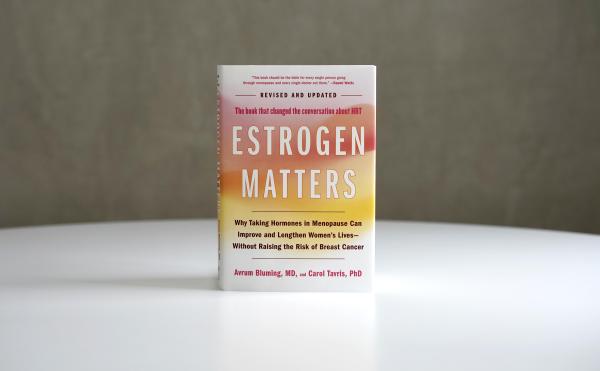
I’m slowly making my way through the book Estrogen Matters (2018) by Avrum Blum, M.D. and Carol Tavris, PhD. It’s deluge of science-based information has fast become the Bible of the menopausal transition set. It is helping me to better understand everything surrounding HRT. This article delves into what I’m learning about estrogen and brain health and steps I’m taking to maintain physical and mental clarity.
Estrogen Matters is the book that has turned the page on the management of the menopausal transition.
It inspired many female doctors entering that phase of life to do more research absent from their original medical training. Doctors Mary Claire Haver (ob/gyn), Vonda Wright (orthopedist), and Kelly Casperson (urologist) and many more have formed a “Menoposse.” Their mission is to share out what they have learned as widely as they can. They advocate strongly for women’s health and quickly debunk false claims with strong research.
As a result of their work, they have reported that the treatment of their mid-life female patients has improved dramatically. Now, they are cracking open the mysteries of menopause for the world to see. Women are better able to recognize their difficult symptoms related to this time of life as treatable. We no longer have to just deal with them as our “new normal.” There are safe, effective, and long-term health protective options that are readily available to us.
Information matters
As I work my way through the book, I feel a sense both of relief and anger.
Relief, because the shroud surrounding the treatment of menopausal symptoms is now lifting. There is an increasing amount of research-based treatments that are widely available and accessible.
Anger, because of how long millions of women have needlessly suffered.
Let me give a little history and context.
The fallacy of the Women’s Health Initiative (WHI)
The WHI was “the largest prospective study in which women were randomized to take either hormones or a placebo and then followed over time.” (Estrogen Matters, p. 7) The investigators were leading doctors, researchers, statisticians and epidemiologists and the results published in the most prestigious medical journals.
The lead researchers of the seminal WHI study published the results in 2002. Prior to publication, they released this press release:
The National Heart, Lung and Blood Institute of the NIH has stopped early the Women’s Health Initiative, a major clinical trial of the risks and benefits of combined estrogen and progestin in healthy menopausal women due to an increased risk of invasive breast cancer.
With the immediate halting of the study, there was a literal 180 degree shift in the treatment of menopausal symptoms. HRT was suddenly out of favor and considered dangerous to women’s health. It wasn’t until eight days later that the official report was published. A whole week of frightening headlines circulated before the rest of the medical community was able to review the results.
The big lie
Here’s the problem: according to Dr. Avrum, the claims made in the report against HRT were based on statistically insignificant data. In short, the interpretation of the data was flawed, data mined, and a twisted lie. That lie was quickly pushed out to the public through the media. Once the story was out, every doctor counseled their patients against HRT and stopped prescribing it. Millions of women were once again doomed to suffer deleterious health effects.
As a result, a firestorm of fear instantly reversed decades of positive steps in the treatment of women in menopause. Until that moment, HRT had successfully relieved symptoms and protected the longevity and health of women. With one factually inaccurate press release, good treatments were suddenly shut down.
Of course, the question I kept asking was “Why?” Why would researchers spend over a billion dollars and countless years on this study? Why would they misrepresent the actual results? Why would they put women into further risk of bone fragility, brain decline, cardiac disease and general poor well-being? Was it simple misogyny? A way to “make their mark” on the medical field? Stubborn? Lazy?
The answer is, the medical establishment still doesn’t know. Ample review and criticism has long debunked the claim that HRT causes breast cancer or other diseases. Still, according to Blum and Tavris, the lead researchers refused to change their stance. They perpetuated the lie rather than work to correct the damage done. A terrible disservice, indeed.
This year, I started to realize that I was entering perimenopause from a wide array of uncomfortable and disturbing symptoms. I also started to get nervous about the deleterious long-term effects that waning estrogen would have on my overall health.
Learning from the Menoposse
Over the last year or so (at least), I was getting very frustrated. The onset of a bunch of different, seemingly random symptoms really rattled me. These were a few:
- I ran very warm at night, but didn’t get hot flashes.
- I’d feel chronic joint pains that I’d attributed to my active lifestyle.
- I felt anxious about normal things, kept me up at night. Usually, I am famous for my ability to sleep like a baby. Now, I had developed sleep problems. Read more about that in Mid-life Musings: Insomnia
- My usually robust energy tanked easily.
- I’d get random bouts of feeling dizzy or unsteady.
- I felt like my head was in a constant fog, making me unable to think clearly (more on that later).
In a nutshell, my life experience was not feeling so great. None of these symptoms were conducive to a comfortable, productive existence at home or at work.
Last spring, I started to pay attention to the wisdom of the “Menoposse.” I decided to read “The New Menopause” by Dr. Haver. Turns out, I learned that my menagerie of symptoms weren’t random at all. All of them had one thing in common: estrogen decline. I had always heard about “hormones, hormones, hormones,” but I never understood the real impact it had on women’s bodies.
In June, I brought the book to my regular gynecological checkup. Armed with some knowledge, I had a productive conversation with my doctor about my whole experience. We landed on a prescription transdermal spray called Evamist. It is a topical application that absorbs quickly through the skin. This form of estrogen is called estradiol, which is usually made naturally in the body. Now that my body doesn’t make enough, I can manage the dosing myself based on the severity of my symptoms. I like that flexibility and freedom to feel better.
Was brain fog my new normal?
This is what the insidious and disturbing brain fog looked like for me at home:
- I walked around with what felt like a gray cloud surrounding my brain. All the time. It’s weird, but I’d describe it as feeling like I was almost perceiving things underwater.
- My ability to recall normal words in basic conversations had declined. I’d start to speak and I’d literally draw a complete blank. I’d pray that the person I was talking to would just know what I was thinking.
- I’d open the fridge, and not remember for the life of me what I was looking for. Could have been food, could have been keys.
- I’d walk into a room, stop, and not know why I went there.
These things are all included in the classic “you’re getting old, get used to it” trope. Unfortunately, they were negatively impacting everything in my world. It was no longer something cute to joke about.
At work, all of my executive function—planning, organizing, executing plans, talking to my students—suffered. Teaching my students, answering their questions, and making decisions was infinitely harder. It’s really disturbing when you consider yourself an intelligent and capable person. I’d been teaching for almost three decades. Why was this so much harder now? Things should be flowing easily after all of this experience.
I couldn’t accept that this was simply “the new normal,” as I’d often heard was the case. That from now on, I would be a walking shell of myself. Doubt started to creep in, and I wondered whether the fog would ever lift. It begged the question, “is Alzheimer’s in my future?” It was really disturbing.
Once I was on a regular estradiol regimen, the fog noticeably lifted. There was a huge difference in my mental clarity. It’s not to say that I don’t occasionally open the fridge and forget why I opened it if I’m distracted. But now, I can quickly get back on track and retrieve the thing I want to eat. Before, I’d have to just abandon the whole exercise of trying to remember. My thoughts now come to me more fluidly, both at home and at work.
This explains why it got better
I came to the chapter in Estrogen Matters aptly named “Losing and Using our Minds.” The information was eye-opening regarding estrogen’s role in brain health.

Estradiol molecule. (PubChem)
In the simplest terms, estrogen actually helps to grow the brain and prevent the natural decline that happens with aging. There are estrogen receptors in the cells throughout the brain, especially in the areas related to memory and learning. As our natural estrogen wanes, so does our mental acuity.
Estrogen Matters presents myriad research studies relating to estrogen’s positive effects on the brain. It plays an important role in stimulating neuron and synapse growth, thus increasing neuroplasticity (the brain’s ability to adapt and change). This fortification of the brain, in turn, plays a significant role in preventing dementia later in life.
I learned three important things regarding the window of opportunity for estrogen’s benefits:
- It is crucial to start taking estrogen early, within the first ten years of menopausal onset. This is long before any mental aberrations surface.
- Starting estrogen therapy after symptoms arise (more than ten years post-menopause) is too late and can actually be detrimental.
- If you are taking estrogen, the protective benefits seem to end once you stop taking it.
In short, you need to start the brain fortification while you are still healthy in order to maintain brain health. You also need to stay on it to maintain the benefits.
How does estrogen improve brain health?
Basically, estrogen increases the things the brain needs and prevents the buildup of things that are bad for the brain. Too much protein, plaque and calcium deposits lead to brain breakdowns. Estrogen enhances the communication between cells, improves cerebral blood flow, and promotes glucose uptake and metabolism in the brain.
This just scratches the surface. There’s a longer list detailing estrogen’s brain benefits on pages 186-187.
My world has improved
In the five months since I started taking estradiol, I am feeling so much better. Most of my physical symptoms have alleviated. No more unexplained joint pain or random dizziness. I’m more calm in general and I’m sleeping more soundly again. Thankfully, the insidious brain fog has lifted.
I feel so much stronger at work this year. When I went back in September, I felt like my classroom management skills had improved. I was able to think and respond with mental agility. Multi-tasking was more fluid. I’d suffer less confusion and muddiness of thought.
I now recognize myself and the brain I was used to using my whole life. All from a couple of sprays on my inner arm every morning.
While those sprays don’t help my increasing impatience or my desire to retire ASAP, they do reveal something revelatory. I do not have to spend the second half of my life in a fog. I can still challenge myself mentally, have more fluid conversations, and maximize my creativity. That will go a long way towards enjoying decades of vibrancy in retirement.
Conclusion: Do your research
Estrogen Matters is dense resource with tons of information to digest. I’d suggest that if you really want to get into the weeds, read it yourself for all of the details. There is so much to digest, including a critical review of the alternative treatments for menopausal symptoms.
Treatment through the menopause transition is individual and should be determined by each woman and her doctor. Hopefully, the doc is properly trained to treat people in this period of life. The sad truth: the medical field has a lot of catching up to do. Menopausal training has been fiercely inadequate and has not fully caught up to the latest research.
This is why women need to be well-versed in this time of life. We will all get there, should we live that long. We deserve to live our best lives, in the best of health. HRT is just one of the tools in our health toolkit that should be at our disposal.
Below, I’ve linked many of the resources I’ve looked at over the past year. I encourage you to click around and check these out. They have really helped take some of the fear and confusion out of this time of my life.
BOOKS:
Estrogen Matters: Why Taking Hormones in Menopause Can Improve and Lengthen Women’s Lives-Without Raising the Risk of Breast Cancer (2018) Avrum Bluming, MD and Carol Tavris, PhD
The New Menopause Mary Claire Haver, M.D.
WEBSITES:
Estrogen Matters
The ‘Pause Life Dr. Mary Claire Haver
INSTAGRAM:
Dr. Mary Claire Haver
Dr. Vonda Wright
Dr. Kelly Casperson
MENOPAUSE PODCASTS:
Perimenopause WTF?
Energized With Dr. Mariza
MY PERSONAL PERIMENOPAUSAL ARTICLES:
Not for the Faint of Heart
Mid-Life Musings: Insomnia
Phytoestrogens and (Peri)Menopause
Empowering GenX Women: Navigating Perimenopause With Expert Guidance
Validating Fitness Strategies: Gymnastics, Nutrition, and Bone Strength in Perimenopause
Building Muscle Mass in Perimenopause
Improving My Cholesterol in Perimenopause

 Stacey's Headspace
Ughhhhhh I’m in it deep too
Just went to the gyno the other day n got my hormones tested. I’m going to beg for the estradiol and the progesterone… which I was actually taking until a few months ago. I didn’t feel any less irritable so I stopped…. BIG mistake!
LikeLiked by 1 person
Very interesting and very informative.
LikeLike