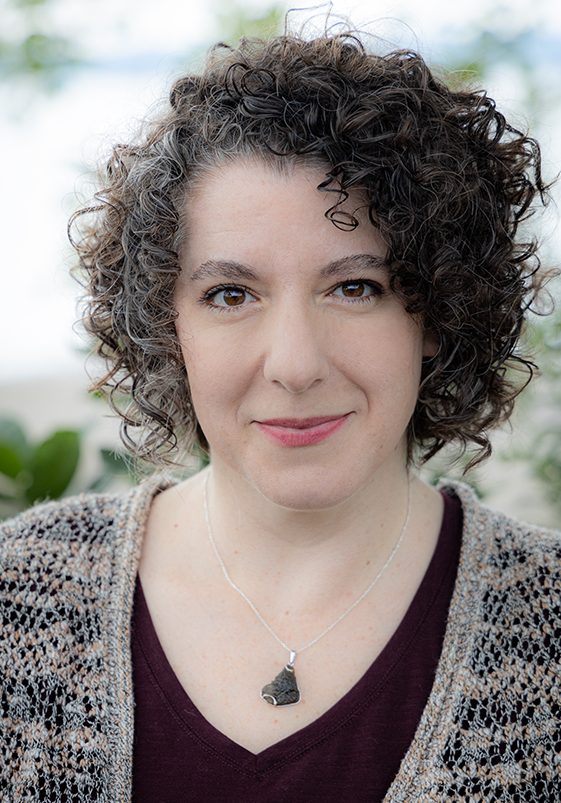

Genetic testing for cancer markers feels like a big deal. It’s like walking a tightrope of wanting and not wanting to know what the future might hold. This is my experience.
Running throughout my family’s history, there are weird and seemingly random incidences of different cancers.
On my mom’s side: when I was two years old, my grandfather died from colon cancer that they found around the time he turned 50. From diagnosis to the end of his life was a very short time.
Decades later, my grandmother was diagnosed with thyroid cancer, I believe in her late 60s. She had an extensive surgery to remove a gnarly tumor which resulted in the removal of her larynx and a required stoma (a hole in her throat that she would breathe through the rest of her life). Ever the fighter, she lived another two decades, used a Servox to speak and eventually learned the graceful art of esophageal speech. Basically, she buzzed and burped her conversations.
My dad, at 52, also succumbed to thyroid cancer, after a tumor had grown down and around his trachea. Like my grandmother, he also had an extensive surgery that removed part of the trachea and his larynx. Sadly, a few days into recovery, a mucus plug blocked his airway and they couldn’t resuscitate him. Yes. It was as awful and horrifying as you’re imagining. He died when I was 22.
My mother, at 69, developed asceites (fluid buildup) in her abdomen. Concerned, she drove herself to the hospital, where they drained five liters of fluid. Turns out that was a result of advanced peritoneal cancer. She died in 2020, just before her 73rd birthday. It was a terrible way to spend the last four years of her life. You can read all about her in my tribute memoir, What Ronnie Sue Knew: Recalling a Life of Love and Sparkle, available on Amazon.
Then, there’s me. At 23, I developed a strange lump in my neck. At a doc visit for some abdominal issues, knowing my family history with thyroid cancer, the doctor suggested I get a scan and biopsy of the lump. Diagnosis: early stages of thyroid cancer. (!!!)
I had two surgeries to remove the diseased thyroid. In the first surgery, the surgeon took part of the diseased gland and claimed he got a clean margin. That was not good enough for my endocrinologist. She insisted I go in for a second surgery (different doctor, different hospital) to remove the entire thing. I did so, and now I take a tiny pill every morning to replace the thyroid hormone my body no longer produces. I’ve been in full remission for 30 years.
Fast forward to 2025. I had switched my general practitioner and we were reviewing my family history. She took one look at the cancer history and immediately suggested I go for a genetic testing panel to see if there were any cancer markers of which I should be aware. From there, I took her referral, went downstairs and made an appointment with a genetic counselor. Good thing I switched docs this year. My last one never mentioned genetic testing as an option.
Visiting the genetic counselor
The genetic counselor was a nurse practitioner At the appointment, she asked me questions about the incidences of cancer in each branch of my family history. She sketched a lineage chart in pen on a single piece of paper to track everything. It felt old school, which I appreciated.
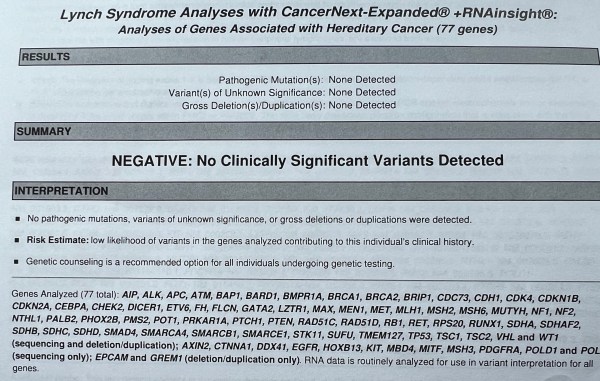
She explained that there are around 22,000 different genes and there are 77 that are currently tested for. There are new tests that come out over time, but for now, these are what they look for, including the dreaded BRCA genes (breast cancer markers). She took my blood, packed it up, and I went on my way.
A month later, I returned for the follow up to discuss the results. The technician took my blood pressure (103/73 – nice) and I waited for the genetic counselor to come in. I had no idea what to expect and was praying it wouldn’t reveal some hidden gene mutation lurking in the background.
She walked in with the results. “Well, this will be a very quick visit,” and handed me the printout.
There, in bold letters, it said: NEGATIVE: No Clinically Significant Variants Detected. I did a little happy dance inside my head.
She went back to her hand-written diagram of my family history. All of the various incidences of cancer were pretty rare, and the thyroid issues, while they could be hereditary, were not necessarily a genetic mutation issue.
With an unconcerned tone, she reminded me to check in every couple of years to see if there were any new markers to test for. In five minutes, I learned that my blood is clear of mutations. That felt pretty good.
Pros and cons of genetic testing
Why get genetic testing done? The purpose is to reveal whether or not you have a genetic predisposition for certain cancers. Having a marker doesn’t necessarily mean you will get that disease. You just may be more likely to get it. It’s still a roll of the dice. Also, of the tens of thousands of existing genes, they only test for 77. It feels like a needle-in-a-haystack-ish effort.
If there are only tests for less than one percent of the genes that exist, why bother doing the testing? If there are other markers that could be hiding in the background, we’re still getting an incomplete picture.
This is my hot take. Accurate knowledge is power, and we must decide for ourselves what to do with it. Having it can make us more aware, informed and prepared to catch something early. There’s always more to know; that’s the nature of science. It evolves as we learn more. I chose to dig in a little and be ready to arm myself for any potential health threats.
Of course, putting too much stock in a result can make for a miserable mental existence, especially if you’re prone to anxiety. Having knowledge, especially if a test result doesn’t play in our favor, can lead us down a dark rabbit hole. That’s why Dr. Google is so precarious for people wanting to learn more about their health concerns.
In my case, since there were such odd instances of different cancers throughout my history, it felt better to know. Now, it also gives me a little peace of mind. Knowing that my genetics have no known markers and my kids have half my DNA, I have stronger hope for a healthier future for them too.
Of course, having a clear genetic report doesn’t absolve me of the responsibility for making the best choices from day to day. That’s an ongoing commitment to my health and well-being, and I take that very seriously. After all, my goal to climb a mountain at 80 still stands. But at least I know, at least as far as those 77 genes go, nothing is working against me under the surface.
In the end, I’m glad I got the testing done. For now, I can put it on the back burner of my brain and go about my lovely life.

 Stacey's Headspace
I’m glad you had this done. It gives you more peace of mind.Sent from my Verizon, Samsung Galaxy smartphone
LikeLiked by 1 person
This makes me very🩷 happy
Lona Benney Kaplan “You gotta have art…”
LikeLiked by 1 person
:) Me too.
LikeLike