

For half a year, I have been recovering from a ruptured Achilles tendon. The gunshot snap. The boot and crutches. The long, painful, drawn-out healing process. Here’s how strategic healing, positive mindset and proper preparation made the first six months of my recovery go smoothly.
When you are 53 and doing athletic things, you wonder how long your body will hold out. It’s always a whisper in the back of your mind.

Science always reminds us that you have to work much harder to keep up your strength in your second act. Despite the caveat of time working against us, I believe that you can maintain strength and mobility. It just takes a lot of consistent effort.
So, when life deals you a big injury like an Achilles rupture, it forces you to pause and reflect. What kind of toll will this injury take on my energy reserves?
Defining strength
I have tried hard not to let the difficulty of this injury define me. Instead, I’ve used it as a way to redefine what strength means to me.
Strength is having the fortitude to be patient, weather storms, and trudge forward wisely even when navigating your situation seems impossible.
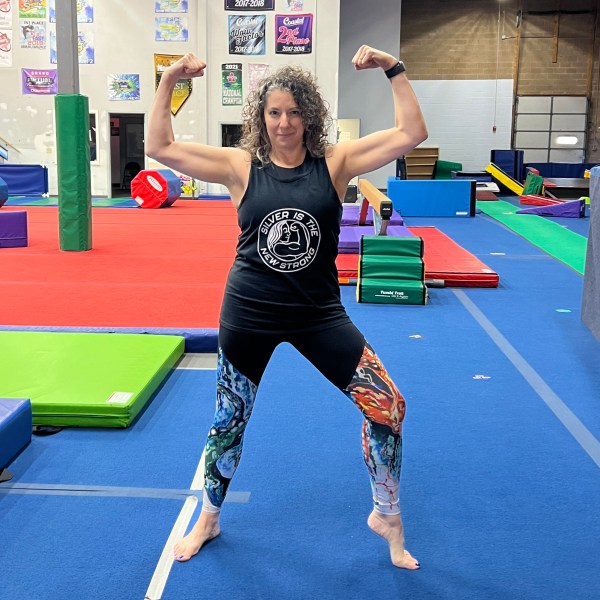
Applying that definition to our daily decisions when injured looks like this. It isn’t about wondering if you can do something. Rather, it’s about how you will manage each challenge.

Right after the snap last December, I sat on the couch for two weeks, sad and evaluating my existence.
In that snappy instant, everything changed: my habits, my passions, all because my most important walking tendon tore in half. Major life reconstruction would be underway in the foreseeable future.
My greatest concern was my future in motion. I kept hearing the doctor’s rolling in my head: six to nine months, maybe twelve. I couldn’t fathom the thought of restructuring my entire life for that long. It seemed like an eternity.
Strategic, mindful healing
The only way to approach this kind of life change is to be strategic. Pondering and planning of each next move actually helped distract me from the depressing reality of a long, painful recovery.
Daily strategies to reach attainable goals kept me ahead of the curve. The key to recovery was in two steps:
First, I figured out what I needed. Then, I found creative ways to achieve those needs.
Here are some examples of the early problems I had to solve:
- How will I get from the couch to the kitchen?
- How will I get into the shower with one foot?
- How will I navigate stairs?
- How will I walk with no support?
- How will I get back to work as a dance teacher?
- How will I get back on the trampoline? (For me, that’s a need.)
Different facets of strength
Physical strength
Most of the strategies required me to build and maintain physical strength in my upper body and the uninjured leg. I had to build pistol squat strength to stand up. To navigate my space, I needed upper body strength to use crutches. Initially, I scooted up and down the stairs on my seat. Eventually I built confidence to use one foot, crutches and the railing.
Doing strength workouts, even early in the recovery process, were a huge boost physically and mentally. It showed me that there were things I could control as my body healed itself.
Emotional strength
Getting back to work presented a whole universe of challenges, which required the strength of patience and grace. I had to give myself permission to do less of what I’m used to doing so I could do more healing work.
Examples? To get back to work, I needed students to help demonstrate skills in class. I had to slow myself down when traversing the halls. I had to accept that being there and trying my best was enough.
Cognitive strength
And getting back on the trampoline? That required me to use the strength of wisdom. I needed to know what was safe and what was too much, too soon.
Listening to my body’s cues helped me evaluate when something was possible and when I should wait. My physical therapist also helped me to set the parameters for moving forward. There was a lot of inching forward from day to day. Acting wisely helped the whole recovery process move in the right direction.
A well-considered, strategical approach empowered me to determine my own healing path. I also had to accept the difficulty level of the challenge of carrying out each effort. And believe me, it was all really difficult. But, difficult things don’t scare me. That’s because I go in knowing I had the power to recover.
Maintain a positive mindset
Being forced to stop, sit on the couch and slow my roll gave me time for introspection. What was my attitude towards my ability to recover from an injury this big? To set the stage, it was essential for me to have a positive mindset.
From the beginning, I made a firm commitment to a complete recovery. However close I could get to my pre-injured self, I would do the work required towards that goal.
When you believe in your heart that you can absolutely make forward progress happen, you fortify your recovery. When you stumble or take a step back, it’s all a part of the process. Taking an active role is much easier when you believe your efforts will be fruitful.
“Have patience and grace” was my personal mantra. In recovery, you must accept that not every day will feel like progress. Progress isn’t ever linear! Of course, I’d often get frustrated that recovery crawled along. I am an impatient person by nature. I needed regular reminders that getting there slowly was much better than experiencing a major setback. I had to give myself permission to take baby steps. Some days, I wouldn’t feel as strong as the day before. But, I knew that I just wasn’t there: yet.
Small steps lead to big progress. Getting up in the morning often felt like a huge backslide. The stiffness and pain often felt like it would never ease. But it did, eventually. I’d wiggle my ankle, do range of motion exercises and soon, I’d be on my way. Pain turned into discomfort. Discomfort eased each week.
Now, six months later, there’s no pain from the repaired tendon. I can’t always say that about the rest of my body. Sometimes, the other parts of my foot and ankle aren’t super cooperative. Compared to the early days of recovery, I feel much more comfortable in my existence as a mover and shaker.
Commit to proper preparation
My daily movement preparations are a reflective response to the challenges of recovery. This is especially true at the gym. I’m trying hard not to sustain further injury, and I’m trying to keep edging forward in developing better technical skills.
As a result of the recovery experience, I’ve developed many prevention strategies to ease into workouts.
- Prophylactic ankle taping to prevent excessive flexion and Achilles stress. This is necessary to protect the healing tendon as my skills return.
- Extended warm-up using a Theraband, graduated ankle exercises and slowly increasing intensity of dynamic drills.
- Testing the ankle strength slowly by introducing one new skill each week. It could be a harder surface, a new combination on trampoline, a higher box jump.
- Balance training is improving the strength of those tiny stabilizer muscles in my foot and ankle.
- Focus on the fundamentals to strengthen both the neuromuscular pathways and my confidence. When you approach movement with clean technique and confidence, you are less likely to sustain an injury.
- Proper nutrition and hydration goes without saying. Feeding the body what it needs to recover isn’t an afterthought. It’s a requirement for healing.
Lingering challenges
Like I said earlier, I’m not completely through the recovery. There is one thing I’m still struggling with: single heel calf raises.
My calf muscle and Achilles tendon are building nicely. But the entire foot/ankle/calf complex still hasn’t fully returned to full strength. I still cannot do a full-range single calf raise on the injured side. Not without holding on to a stair rail. I work on these regularly and do eccentric strength work to help. But even at the six month mark, this movement is taking the longest to return.
It is so frustrating, since I can do box jumps, trampoline and light jogging without any issue. That said, I keep applying a strategical approach to keep taking those baby steps. Eventually, I’ll get there.
Looking ahead
Despite that challenge, I’ve come a very long way in 6 months. This video is my ode to healing.
The strategies that I talked about above have helped me reach these recovery milestones. My long-term goal is to evade big injury as I continue building efficient movement technique.
In six months, I’ve experienced so much progress.
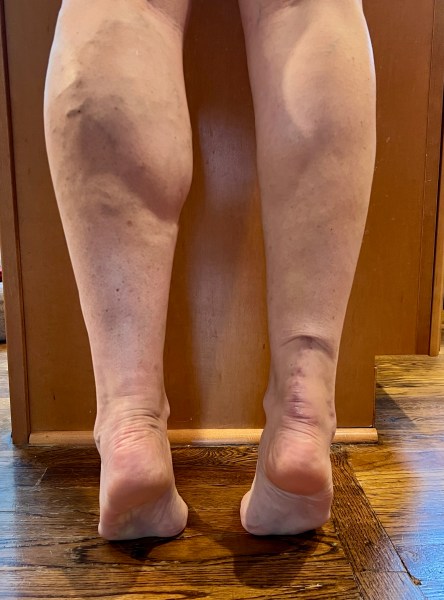
With Achilles injury, every small step forward feels like a huge celebration. For all of the daily pain and frustration I experienced, I’m proud of the work I did to get here.
I am finally seeing a brighter light at the end of that dark tunnel. I’m not completely through quite yet. To be honest, I’m not sure I’ll ever be all the way through it. This is a fluid, lifetime recovery process. But at this point, I am highly encouraged that I can get closer every day.
For an overview of my entire injury experience, read Recovering from Achilles Tendon Rupture: A Personal Timeline. It distills the whole process as I achieved each milestone of recovery.

 Stacey's Headspace
One thought on “Achilles Recovery: My 6 Month Snapiversary”