

Coming back from a physical injury is a great feat. Conquering the mental fallout is like winning the Olympic gold medal. This article chronicles the steps I took on the long road to overcoming fear. Trust the process.
I’ve written a lot about managing fear and the effects our Lizard brain has on our ability to overcome it. It comes with the territory of being an adult gymnast. Heck, it comes with being a gymnast in general. Even our golden girl Simone has human fear. She said in her Netflix documentary series Rising that the Yurchenko double pike terrifies her every time she chucks it.
It’s helpful to know that even Simone gets scared. And somehow, she does it anyway.
The main source of fear: injury
Almost a year ago, I broke my right foot chucking a newly-acquired roundoff back onto the mat. I wasn’t completely comfortable with the skill. Somehow in the air, my feet misaligned and my right foot landed on the mat, slightly inverted. Cracked the 5th metatarsal and was out of commission for almost 2 months, hobbling around in a walking boot. That story starts here.
My Lizard brain constructed a massive, fortified wall of fear to prevent me from doing that kind of damage to myself ever again. I wasn’t sure I’d ever be able to get past it.
Healing physically
Once I was back in the gym, I slowly rebuilt. I started slowly. From moving my ankle to putting weight on the foot. Walking on it in shoes, then barefoot. Driving a car. Bouncing with shoes then without shoes. Jumping on the floor and then vaulting on a springboard. Every advancement had its own hurdle.
There was some degree of pain every day for many months. Pain can be a powerful de-motivator. But, I knew that if I didn’t do the work to get stronger and more mobile, I would never rebuild. Bones heal in time. How you spend that time healing makes all the difference in what comes next.
Healing mentally
After the physical break healed, I rslowly egained strength and mobility. That’s when the mental healing kicked in. Simone, after her twisties, caused her to pull out of Tokyo. She took two whole years to figure things out before she even considered stepping foot in the gym again. Then, she started training from the beginning.
Thankfully, she kept herself safe. She had enough presence of mind not to put herself in the position of suffering catastrophic physical trauma. Unfortunately, her mental trauma was firmly entrenched.
Seeing her rebuild and shine on her road to Paris gave this Geriatric Gymnast hope.
I recognized that in breaking myself, my brain had suffered trauma. I had to acknowledge that it would resist my every step towards rebuilding my gymnastics skills. I would have to pay close attention to what my brain needed before it would unlock. I’d have to test my body like the tortoise: slow and steady.
Learning through healing
Yes, this was frustrating. But here’s what happened when doing that slow, steady work for months:
- I became more analytical.
- I became more detail-oriented and focused on the fundamentals.
- I learned the value of rest and processing my experience.
- I became more attuned to my body and brain’s needs.
- I gave myself grace.
- I built a stronger foundation and brain-body connection.
- I learned the importance of building consistency to make habits permanent.
- I learned to trust the process.
The fallout of fear
In the months since my foot healed completely, every time I looked at the TumblTrak I’d shudder. The thought of flipping backwards put me into shutdown mode. I’d literally stand on the bed with my arms up, and I’d freeze and walk away. I started to think, maybe I should just let it go. Maybe I’d stick to front tumbling there and be done with it. It would be fine. I’m 52. I’m allowed to say no.
The thing is, my back tumbling on the trampoline is great. I even rebuilt the roundoff-back tuck connection there. Sure, it was bouncier and I had more time to execute each piece of the skill. Sure, the landings were easy on the joints. Sure, my technique was improving. All of that was true. I just had to figure out how to unlock my brain and convince Mr. Lizard that I was, in fact, capable of not breaking myself. That wasn’t easy, and it took a very long time. It also took many angles of attack.
There had to be a process to move forward. And, I had to trust it to work.
My process
Goal setting is the best way to learn something new. Defining smaller steps that will take us in the right direction. In this light, I tacitly created two overarching goals for myself. Then, I discovered many different steps to follow that eventually led me to my big breakthrough.
Goal 1: Improve my back tuck technique on the safety of the trampoline.
Step 1: Head alignment
Often, when learn to chuck a back tuck, we also throw our head back. This is because we naturally want to look where we are going. That’s actually a no-no. That causes you lean back and travel. It also kills your height, which gives you less time to rotate, which leads to ankle-crunching landings. Bad. Keep the head aligned with the spine.
Step 2: Set the arms high before you launch.
This is so hard because our instinct is to protect our center, which often results in T-Rex arms. Setting high gives us the direction we need to go: UP. But mentally, it feels counterintuitive. This took time to settle in, and I still have to think hard and plan every time I chuck it.
Step 3: Activate the front body.
Even though we are going backwards, what powers the move is the tuck position, which needs the front body muscles. Whenever I prep my set, I squeeze my lower abs and hip flexors. It helps me remember to employ them as soon as I stretch up and push off the toes. Every time I remember, it’s an easy rotation and I land in the same place. Win.
Step 4: Use the breath
I found that creating a specific breath pattern helps allay the fear. Set high and inhale deep. On the backswing, exhale. It’s a simple detail that helps me to lock in and commit to the effort. This is what helps to stop the fear freeze when I add to the challenge.
Of course, it would have been easy just to keep my back tuck on the trampoline forever. But, I didn’t want to. I knew my body was able to do more. It was just a matter of how to get there. Thus, the need for…
Goal 2: Keep raising the bar with each success
Step 1: Add a panel mat
I needed to start bridging the gap between the tramp and track. Putting a panel mat on the trampoline gives a firmer surface on which to push off. It’s still safe and bouncy, but it adds more resistance and you can start to learn to push harder.
Step 2: Standing tuck drill onto a wedge.
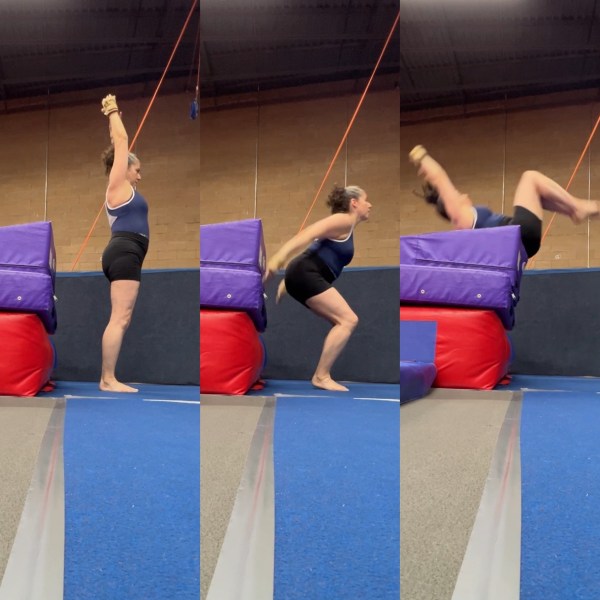
This exercise gave me the experience of pushing through more resistance.
The trampoline, even with the panel mat, is still super bouncy and doesn’t mimic the resistance of the much-tighter TumbleTrak. Pushing off the floor is a different sensory experience and helps build push strength in my feet and calf muscles.
Step 3: Belted back tuck on the TumblTrak.

Lisette and Tammy basically making sure my demise is not imminent.
Super super super scary to make this transition. The only reason that it unlocked was because my trusted gym buddies were giving me a boost and protecting me. Otherwise, it would have been a no-go.
Step 4: Back tuck into a pit.
This was hard since we don’t have a pit at my home gym.
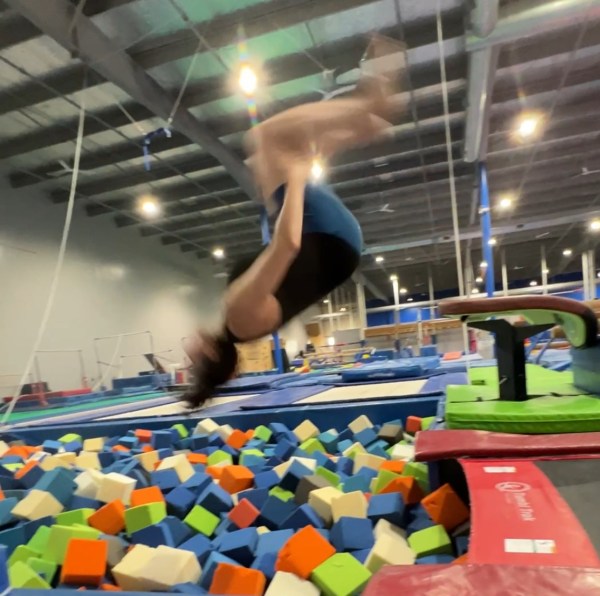
I visited a new place this summer and got to flip into a pit for the first time.
It gave me the opportunity to push off a TumblTrak surface, solo, without landing on a mat. This allayed my fear of landing with my foot out of place. It enabled me to write the new pattern in my brain.
Step 5: From the track to a mat in the pit.
This was essential for me to build trust in my technique.
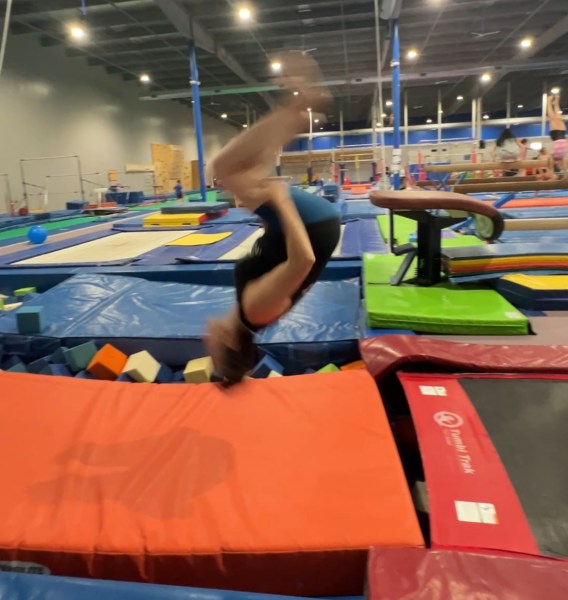
Landing this easily would ensure I’d safely land on the track.
Step 6: Moment of truth
Land it solo on the TumblTrak. I will admit, there was a moment when I almost gave up. Tammy offered a phantom spot (hand placed on my back) to get me started. This gave me a tiny sensory reminder of the security of the belt. After that, Mr. Lizard relaxed a bit. Then, I chucked them over and over again.
Looking forward
Of course, time will tell if this all sticks. This breakthrough was day one. I won’t consider this a fully-developed skill until I can chuck them on any given day with little pause. But, there is a significant win here. In trusting the process and listening to my body, I chipped away at the fear, slowly but surely.
Coming back from a physical injury is a great feat. Conquering the mental fallout is like winning the Olympic gold medal. When you create a path to success, and trust the process you follow, you can defy the odds.
In this way, we can all be a little like Simone.

 Stacey's Headspace
Very helpful for all types of exercise.
LikeLiked by 2 people