

In gymnastics, every choice you make is an important one.
Each skill, whether a handstand, salto (flip) or a complex combination of moves, requires a laundry list of technical requirements. When you are first starting out, that list can be very intimidating.
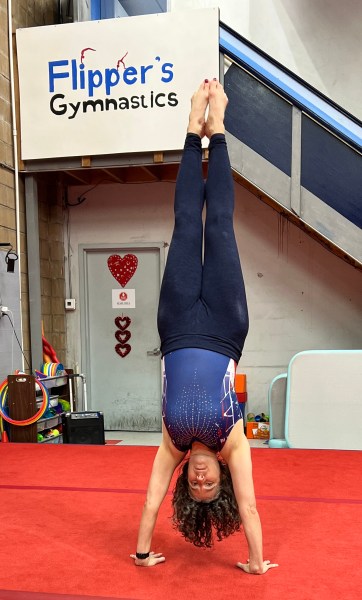
I coach adult gymnastics at Flipper’s Gymnastics in Ramsey, NJ. We now offer adult classes three times a week. One of my favorite classes to teach is our Thursday night fundamentals and mobility class.
We started the fundamentals class because the Tuesday and Sunday adult offerings seemed too advanced for people just starting out. To be honest, I wanted our gym to offer the kind of explicit instruction I wish I had when I was starting my gymnastics journey at 36. When I started, I knew absolutely nothing about the sport (other than enjoying watching the summer Olympics on television), and I was introduced to a whole universe of mental, physical and emotional conditioning.
16 years ago, I would dutifully come to class, do the exercises, try new things, ask questions, and watch the more experienced adults do their thing with stars in my eyes. (I Am A Gymnastics Addict talks about my humble beginnings as a working mom-turned new gymnast.) It took me a very long time to really absorb why we did things, what the proper progressions were, and what to think about to avoid injury. Often, I’d chuck a skill, usually wrong, but when a back handspring went askew or my front tuck traveled four feet forward, I had a hard time figuring out why. So, I’d chuck what I could, often reinforcing poor technique, hand placement, eye focus, etc. I also suffered lots of injuries as a result. Read The Road To Mastery, which talks more about my struggles with all of this.
The question of “why” always gnawed at me: Why was I traveling on an angle? Why are my hands so wide? Why is my front tuck traveling so much? Why is my back hurting so much? The truth is, there’s always a reason (other than “I’m getting old”), but you really have to dig in order to figure it out. What helps is when you have a good pair of coaching eyes on you who can point out the important details in real time that you can’t see yourself.
What are the fundamentals?
Some adults are returning from their long-deserted recreational gymnastics or competition days. Others are walking into the gym for the first time, looking for an interesting way to keep in shape. I’ve flipped with so many adults through the years, and as I’ve studied their technique, the good, bad and ugly, I’ve learned that there are certain fundamentals that are simply required to learn at the very beginning of the training process.
While I’ve had good coaches throughout the years, I’ve learned so much more about the application of technique from the adults I’ve trained with in class. Most notably, my training partner Tammy has really helped me understand all of the connections that I’m going to discuss here. It takes a village.
This article focuses on the following fundamental concepts: the hollow body, the tuck position, maintaining the vertical, eye focus, and the importance of commitment.
The Hollow Body
The hollow body was a fundamental concept that took me a long time to understand. Because I started as an adult, it wasn’t drilled into me like it would have been if I were a kid. We did scores of crunches, roll-ups, v-ups, hip lifts, etc, but I think an intentional focus on hollow body early on would have made a huge difference in my training.
Hollow body applies to so many skills in the gym. Basically, it is about locking in your core and every muscle group, to support an outstretched crescent shape. You use it in handsprings, back layouts, bars, handstands, vaulting – pretty much anywhere. It’s not an easy position to hold naturally, but it is required if you’re a gymnast.
These are some hollow body progressions I use with my adults at the beginning of the class to help them connect to all of the muscles necessary to transfer the hollow body position to the trampoline, floor, TumblTrak, wherever your favorite (or not so favorite) apparatus might be.
Start on the ground
Lay on your back with your arms and legs stretched in opposite directions. Your arms should be pinned next to your ears.

After an inhale, you lift your legs, shoulders/head/arms (they are one unit) off the ground a few inches, so they are hovering off the floor. You’ll feel every muscle in your body engaged as you try to hold this position.

At the wall
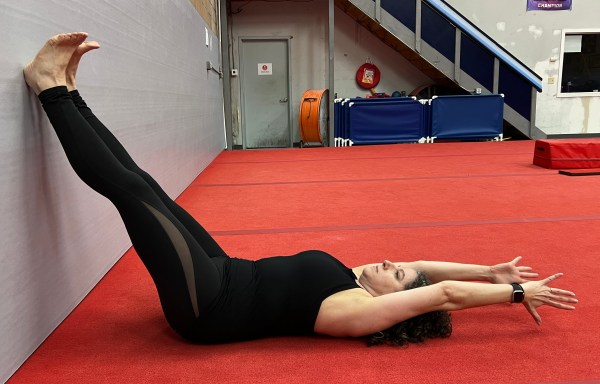
Lay on your back with your arms overhead and place your heels on a wall with your legs about 45 degrees to your torso, flexed feet.

Squeezing the glutes, core (including Kegels – work that pelvic floor!!), quads and calves, slowly raise your hips and let your toes touch the wall. You’ll be in a straight line from your shoulders to your heels. Hold that for a count of 10 to really feel all the muscles required to maintain the position.
Move to plank
In plank holds, you can maintain that same crescent shape from your toes to your shoulders as your hands and arms support the plank.
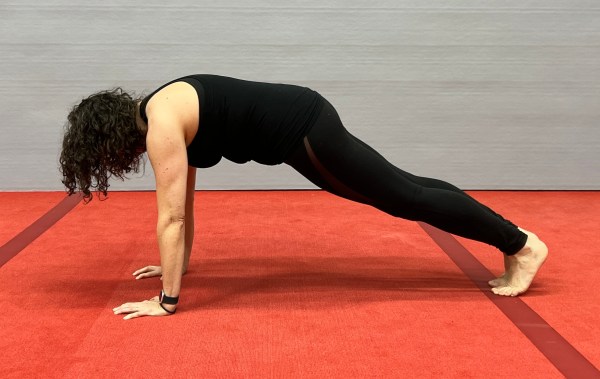
If you want a little extra added boost, you protract (pull apart) your shoulder blades, lean forward, press your finger pads into the floor, and do a tricep pushup without letting your torso touch the floor. All the while, you hold that hollow body position. Not easy, but a great overall body strength builder.
Inversions
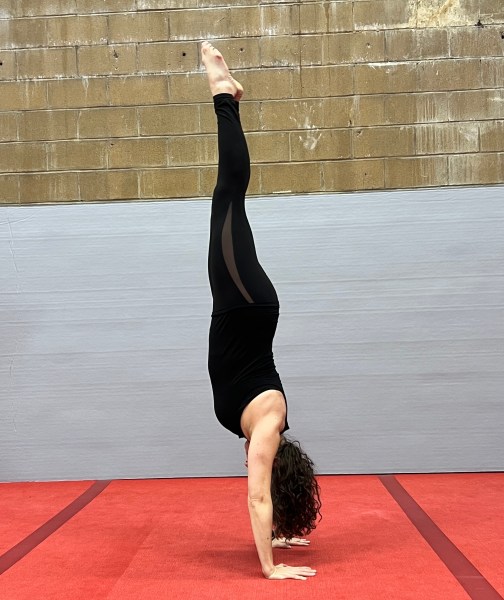
During handstands, you should engage all of those same muscles. Too often, people throw into the handstand and we see a banana back. Ideally, we want to engage those same hollow body muscles to make that straight line from the hands up to the toes.
(Full disclosure: I know I’m not fully vertical here. On the floor, I do get nervous pushing to a full handstand. From past shoulder injuries, I don’t love rolling out of it without a mat surface behind me. But, you get the idea of keeping the hollow body muscles engaged when inverted.)
I try to explain it like the upper part of the front of the hip is trying to connect with the front of the shoulder. When you lunge and kick up, you have to be aware of your front body so you eliminate the banana back and “zip up” your front body.
The Tuck Position
I’ve been flipping for 16 years and officially coaching for about two. Unofficially, I’ve worked with many adults as they’ve tried to master saltos (flips) and gain consistency. It’s so hard, because the adult brain is so rife with anxiety and protective mechanisms (see my post about Lizard Brain) that it often prevents us from accessing proper technique when we are trying to apply it dynamically.
Here are a few floor exercises to help access the tight tuck position:
On the floor, a great way to access the feeling is to balance on your seat in a tight tuck position. Hold it for 5 seconds, then lay out in hollow body for 5 seconds. Rinse and repeat.

From that balance point, roll onto your back and back up to the balance point without touching your toes on the ground. You’ll feel your inner stability muscles firing up.
Transferring that position to trampoline, we do rebounding tuck jumps. Engage the hamstrings, point the toes, bring the knees to the shoulders and touch the shins with their fingers. This repetition creates the neurological pathways necessary to advance it to a flip. Notice the arms always return to the ears.
Most people are able to get that while bouncing up and down, but when it comes time to actually throw the 360, that information tends to go out the window.
The longer the checklist of instructions (jump high, hips up, grab shins, see the wall, open up, land standing up with arms overhead), the fundamentals tend to go out the window because you’re thinking of too many things in a split second.
This is why the fundamentals are SO SO SO important. They have to become second nature before you can apply them dynamically with any consistency. But once you do, and you feel that tight, quick rotation, your brain sends all that good dopamine as a reward for a job well done.
The goal is to access the fundamental technique easily so that you can automatically apply it when you are also dealing with the rest of the checklist. Then, you’ll get that dopamine treat and (hopefully) be inspired to hit all the checklist elements so you can land on your feet every time.
Tucks for safety
The tuck position is also really important for when you mess up and have to bail on a move. Let’s say you throw that front tuck, but for whatever reason, the mental commitment is not there. You miss a step, your don’t rotate quickly enough and you suddenly realize you are not in the right place mid-air. The BEST position to be in, especially on the trampoline, is the tuck.
Throwing your limbs out to “catch yourself” actually puts you at risk of a nasty injury (rotator cuff tears, neck or back strains, wrist or elbow jams). But remaining in the tight tuck is actually quite protective; everything is placed to minimize the risk of jamming on impact. As long as you are positioned safely above the trampoline bed, the worst that happens is you bounce like a ball.
Maintaining Vertical Alignment
Seems simple, but maintaining a standing vertical position with arms overhead is exceedingly hard for many adults. Add any kind of jump, twist or flip where you have to land back in that alignment is an extra added challenge.
Standing tall
During warmups, we work on postural alignment, shoulder mobility exercises (which can be hard for tight adults), and standing tall, eyes looking forward, arms up, shoulders down, elbows straight and reaching behind your ears.

Jumping vertically
Once the standing vertical is established, we also jump in that position: on floor, trampoline and/or TumblTrak. You can quickly assess the mobility of the shoulders and the strength of the core when adults try to hold the vertical position in a dynamic exercise.
Vertical inversion
During handstands, the arms and torso are one vertical unit, starting and ending with the arms up and behind the ears.
As you lunge and reach, you are trying to keep the arms by the ears as you move into the handstand. As you kick down, you press into your fingers, engage the back muscles and quickly come back to the starting position. It’s a good way to reinforce that alignment dynamically.
On the trampoline, every landing should return to the same place: with arms over the head and the eyes focused on the wall in front of you. (More on eye focus in the next section.) As you master flipping, landing vertically is essential to connect individual skills into combination moves.
Eye focus

Knowing where you are at all times is paramount to advancing your skills. Over time, you develop your gymnastics vision, visual skills that improve outcomes when you flip.
Just like baseball players learn how to read a fast ball, the gymnast must be able to recognize where their bodies are at all times when they are flipping and twisting, sometimes at the same time. (Think Simone Biles in her triple double on floor. Insane understanding of her body in space.).
Before they develop their gymnastics vision, adults often start without being able to focus on anything at all. I think much of the anxiety they feel is linked to that out-of-control feeling when they get lost when they go heels over head. I experience it while twisting, which is why I have had such a hard time figuring out flipping in more than one plane. But I digress…
When people struggle with landing flips, one of the questions I’ll always ask people is what are you looking at when you land? Usually, there will be a long pause and a deer-in-the-headlights gaze.
That’s when I introduce the smiley faces that we draw in chalk on the wall. (That’s Jimmy to the right.) Introducing eye focus as a fundamental early in training really helps give adults an attainable goal.

More often than not, the simple awareness of being intentional with your eye focus is enough to make a significant improvement in your landings.
Some adults have lofty goals
A related story: One of my younger adults, a young man in his early 20s who came in to our gym wanting to learn double twisting back tucks (or some such ludicrous skill far beyond my coaching ability). Of course, this set off my alarm bells, because the guys with lots of strength, lots of excitement (maybe hubris?) and very little technique can get themselves into trouble very quickly. They are often unafraid of chucking their bodies with no real direction, without thinking about what the consequence of a bad landing could be. I didn’t want him in a wheelchair on my watch, so I had to pull him back and get him to look more closely at the fundamentals.
It took a long time to talk him off that ledge, fight his natural sense of impulsivity and impatience, and give him smaller training goals. One of the big goals was for him to actually develop his gymnastics vision, because when he started flipping, he’d often land all askew. I’d ask him where he was looking, he had no idea. I was adamant that he start knowing exactly where he was in space. I knew that when he made the commitment to applying the basics: eye focus, strong tuck, and landing vertically, he would easily figure out how to advance his skills.
Commit
If there’s anything I say with the most regularity and emphasis, it is that whatever you do, you must commit to it. Letting anxiety cloud your process, second guessing or stopping halfway through a skill is always a bad idea that will inevitably lead to more anxiety or worse, injury (been there, done that). We have a saying in our adult cult: “Use your whole ass.” Meaning, don’t half-ass it; go for it completely. If you can’t commit to the whole action, it’s better to walk away and try again another time.
Once my young daredevil started to commit to mindfully absorbing and applying the fundamentals, his mental approach started to change. He recognized the need to understand where he was in space, developed better dynamic body control, and started to respect the anxiety he felt. He also became less of a danger to himself and started to advance his skills safely. I breathed a sigh of relief when he started talking about all of these things in a side conversation. So now, when he starts chucking double-twisting back drops on trampoline, my heart doesn’t jump into my throat, worried that he’ll face plant into the wall or hurtle himself off the trampoline completely. Well done, sir.
Some final thoughts for adults
Learning gymnastics as an adult is both exhilarating and incredibly scary. If you are an adult who is considering entering the realm of inversions, flips and hanging on bars like a monkey, here are a few suggestions I have as you embark on this amazing journey:
- Take things slowly. You are not competing with anyone. Safety is paramount to progress.
- Focus on the fundamentals. There are a lot of them and they take forever to develop.
- Commit to the training. The conditioning is a long-term process to form new physical and mental habits. Trust the process and remember that progress is never linear.
- Enjoy the ride! Whether you land on your feet or fall on your butt, you will learn something new about yourself every single time you go to class.
When you commit to the process, you will absolutely surprise yourself with what your body can do!
Thanks to my dear friend and training partner Tammy for all of the photos and videos used in this post. You can see her amazing work on IG @theneotenyprinciple. Check her out!

 Stacey's Headspace
this was an amazing read Stacey! And great reminders!
LikeLiked by 1 person
Thanks, Kwesi! I figure if I write it down, I’ll remember to do it all!! 😂😂😂
LikeLike
Such good information, Thank you Stacey,
LikeLiked by 1 person
This was super helpful and I will definitely be doing these exercises at home to strengthen my muscles!
LikeLiked by 1 person
That’s great! These will definitely support all of your gym training ❤️
LikeLike
I loved the hollow body exercises and tuck positions we did at the start of class! It really does help you feel it when it is time to put it all into action 💜
LikeLiked by 1 person
It’s one of those essentials that is so easy to forget, but when put to use, makes everything make sense!
LikeLike
Flipper’s is so lucky to have Stacey as an instructor!
LikeLiked by 1 person
Aw, thank you! I’ve learned so much there. I’m grateful to be a part of the Flipper’s family!
LikeLike
Very interesting and informative. I may try two of the core exercises.
Iris
LikeLiked by 1 person
They are really challenging, but you can modify it at any level.
LikeLike
Really enjoyed this post, very helpful and interesting! Thanks!
LikeLiked by 1 person
Thank you, Linda! Glad you enjoyed the read!
LikeLike
😳🫣
I’m super happy with all the progress I made and am looking forward to what the future will bring!
(hollow body handstand is underratedly super difficult)
LikeLiked by 1 person
I’m so proud of your progress in such a short time. The sky is the limit for you!! And yes, getting that hollow body feel to your handstand is so hard.
LikeLike