

In the weeks before starting school, I had a lot of anticipatory anxiety. Three weeks in, things have gotten off to a smooth start. What helps is having a well-developed teaching toolkit. This article shares my simple and consistent protocols that create a long-lasting flow for the entire school year.
After all of the end-of-summer agita about returning to work, I actually feel good about this school year. I really like my classes and the mix of kids in them. The fall production is cast and rehearsals are underway. Expectations have now been firmly set, everyone is embracing the protocols, and things are flowing.
For anyone who doesn’t know me, I teach dance and physical education in a public high school. I also run the drama program after school. My educational offerings are often in a realm where most of my students have little to no experience. Many have never seen a dance studio or enjoyed an evening of theater. My job is to unlock the door for them to thrive in the performing arts.
After almost three decades of fine-tuning, the protocols in my courses and shows are now presented efficiently. I can anticipate and respond to pretty much anything the kids do or say. That’s the benefit of being a veteran educator. I can quickly assist, parry, diffuse, distract, and suggest alternatives on the spot in the moment. And, I do it with a smile and sometimes, a hug.
When we say, I’ve seen and heard it all, we are acknowledging our superpower. We can quickly figure out where go and what to do in order to assist a student in need. It’s rare that we find ourselves completely flatfooted in a situation.
As I start year 29, I thought I’d share many of my well-honed strategies. Nothing is foolproof, and sometimes even my best efforts don’t work. However, the tools offered here have made my life as an educator a whole lot easier.
On day one, I share with students…
My house rules
If there’s one piece of advice I would offer new teachers, it’s this: make house rules that make sense. They should be simple, clear, obvious and easily relatable. Good ones will also encompass multiple, more specific expectations. The best ones are those that you, the teacher, follow naturally. Who better to model the expectations than the teacher herself?
These are posted on the wall so students see them when they walk in the door.
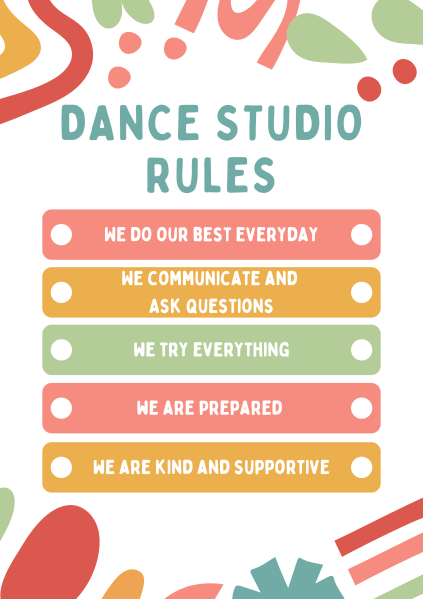
The beauty of these five rules is that they can be followed by anyone at any grade level. Notice that each statement starts with “WE”? That’s on purpose, so they know adults are included in the execution of this contract. Students appreciate clear, consistent protocols that everyone follows. It shows in their day-to-day behavior, and when they don’t follow the rules, it’s easier to course correct.
Let’s look at each one and how it is applied it to the more detailed protocols of class.
1. We do our best
I tell the kids that we must present the best possible version of ourselves in any given moment. Even when we have a bad day, we can choose to present in a manner that feeds into productivity. They have a responsibility to leave their problems at the door, enter class, and do their best. Even when their best is a fraction of their “normal” capabilities, I can see and acknowledge when they are trying.
STRATEGY: Build trust so students feel safe to show the best version of themselves.
- Give them the benefit of the doubt.
- Create opportunities to build positive relationships with those who haven’t shown the best version of themselves.
- Avoid paperwork and work a problem in-house.
- Be a part of a good solution in their problematic decision-making.
- Show them that you have their best interests in mind.
- Give them a chance to correct their behavior in a long-lasting way. Then, acknowledge the effort.
I wrote more about that trust-building on the road to self-actualization in my post-COVID article What High School Students Need.
I typically do not deal with serious disciplinary issues in my class because I work hard to build their trust. It’s amazing to see more challenging kids mature over the years to become more sweet and productive. They often need many chances to learn and course-correct. I think of them like toddlers who have trouble learning to use their words. Eventually, if you are patient, kind and give them grace, they figure out the right path.
That’s not to say that some kids don’t behave badly, despite the rules. Sometimes, they do. Sadly, they have to learn the hard way that their choices do not mesh with creating good community. In truth, a large part of my job is teaching social skills so they understand why it benefits them in the long run. This fundamental principle is what I try to impart to all students:
Building good will on your worst day is always better than taking your feelings out on anyone else.
In other words, be the best version of yourself, all the time, even on the bad days. When students trust the people in their community, they will be more willing to push through their challenges.
2. We communicate our needs
How frustrating is it to face a room of silent, blank faces? The reasons for their silence are understandable. Some students are afraid to stand out in front of their peers. Some don’t know what to ask. Some are just detached from the active learning process for personal reasons. Many simply don’t know enough English to effectively express their needs.
I tell my kids, up front, that they need to start speaking up, even in their language. Google Translate and peer translators are great tools for bridging the gaps for English Language Learners (ELLs). More often than not, there will be at least one student who is willing and able to assist. I’ll often ask the class to repeat an unfamiliar word together, just so they are forced to say something aloud.
I wrote more about teaching English Language Learners in last spring's article Translanguaging in Arts Education.
Effective communication fosters understanding. If they don’t know something, they must ask about it. Even a word with a question mark gives me a clue as to what they need to figure something out. My job is to help them get to the next step in their learning process. Every time they step forward, I see more confidence and curiosity build. The best outcome is when they see their peers communicating successfully with me, and they follow suit.
STRATEGY: Say it, then do it
This method is really effective. I introduce a term, I make them repeat several times, then they physically do the skill. That reinforcement makes excellent brain-body connections that are longer-lasting than just silently copying the teacher. It’s especially effective in our ballet unit, where all the terms are in French.
The greatest feeling in the world is the moment the light bulb turns on in an ELL kid’s eyes. The change between confusion and clarity click. Suddenly, I can see that they are interested, connected, and looking to learn more. When they approach me to ask a question, it makes my day. It’s a gift that keeps on giving.
3. We try everything
So many kids are afraid of trying, often because they are afraid of failing. In my class, the most effective way to learn is to get up and physically do the work. Learning dance is a full body-on process. Observing is not an option for long-term physical skill-building.
On day one, students start to build their learning process in the studio by getting up and trying the basics. I tell them that mistakes are part of the learning process. Failing and trying again is just how it works. This is the requirement: to try everything we do, more than once. In fact, there’s no end to the trying period. Whether they get it on the first or twentieth try, the continual effort is paramount. Building perseverance and grit through challenge is what life is all about.
STRATEGY: Model trial and error
When they see me try and then make a mistake, they learn that it’s okay to fail. I tell them that despite all of my preparation, knowledge and experience, I still mess up often. What comes after the error is the teachable moment. We can brush ourselves off and keep trying. I forget my own choreography and flounder on recalling names all the time. They see me taking a breath, saying “oops,” resetting, and trying again.
Once in a while, I’ll catch them showing one of “their” dance moves. Then, I’ll do a little impromptu trial of their move. If I look silly, we all get a good laugh. If I do it well, I’ve gained a little more respect from the younger generation. They see that learning is a shared experience that flows in both directions.
4. We are prepared
By failing to prepare you are preparing to fail.
Benjamin Franklin
It’s not enough just to have experience. You can’t pivot on a dime if you aren’t prepared. I have spent many hours fine-tuning slideshows, lesson plans and messaging to make the learning experience both efficient and rich. Preparation helps us to anticipate and redirect without missing a beat. It affords the latitude to stop for a moment and pivot it something doesn’t go to plan. It allows for random teachable moments within the big picture of our lesson.
STRATEGY: Plan for when things fall apart
I’ve been casting school shows for over 30 years. In recent years, I’ve been having some trouble filling roles because the casting pool has shrunk down from years past. The pandemic was a major contributor to that, to this day. I’ve had to replace actors on show nights without understudies. It’s enough to make you want to throw in the towel and sit on your hammock.
Preparing myself for an unexpected and massive shift gives me the presence of mind to respond in a clear-headed way. When I am calm, the students follow suit and can respond when I need them. I spend a lot of time throughout the rehearsal process thinking about what I would do if someone drops out. For the most part, I never really have to act on that possibility, but if I do, I’m ready.
In 2016, my lead actress dropped at the end of act one and couldn’t finish the show. I had another actress (not an understudy – not enough kids) step in with a script in her hand. In 2023, an actor had a family emergency and couldn’t finish run. Another student with script stepped in. She did a brilliant job, but it was not without considerable stress on everyone’s part. We got through it, because Plan B was prepared, even if it was just a mental plan in my head.
No matter what chaos is thrown our way, our productions provide beautiful arts-in-education opportunities. The students learn, in real time, that preparation enables us to execute the vision. When the big picture is set, the details are easy, even if they have to change. In the end, the show must go on.
5. We are kind
Of course, preparation is only part of the game. When executing the plan, especially when there are big changes involved, you must do so with the knowledge that not everyone:
- is at the same level
- is on the same page
- understands everything your are presenting
This is especially true when you are teaching English Language Learners. Also especially true when you are teaching performing arts skills. What must underlie all of the above house rules is how we treat each other as we follow them. Before all, we must be kind to one another.
STRATEGY: Demonstrating kindness in myriad ways
For teachers:
- tell students that making mistakes is expected and accepted
- look students in the eye and smile
- see someone struggle and address it as though you were going to talk about that next
- remind students that the expectation is doing their best, not perfection (which doesn’t exist anyway)
- allow for processing time
- randomly check in if someone was struggling with something in the past
- anticipate that something isn’t quite right, just by seeing changes in their demeanor
- try to speak in their native language, even if it is not yours and your attempt is broken at best
- catch kids in the kindness act and publicly acknowledging and praising said act
For students:
- taking off their shoes before stepping on the dance floor. This indicates their understanding that we want to maintain a clean and safe environment for all
- explaining or translating for others
- helping peers memorizing lines
- applauding the efforts of classmates
- boosting someone’s confidence by acknowledging their effort
- being a liaison between a student and the teacher when they are having a hard time
- breaking something down for another student who is confused
Kindness and support encompasses respect for space and self. Taking care of ourselves, each other and our resources ensures that everyone involved wants to keep coming back for more. The spirit of “do unto others” is dogma in our classroom. With kindness comes good will, which fosters strong community. When students have taken it upon themselves to show kindness, my heart becomes full.
Discovering joy
The main reason that I have lasted this long as an educator is the joy I experience every day. Once class or rehearsal starts, we have a ton of fun together. That’s the operative word: together. Yes, I am teaching content and skills and they are trying their best to learn it. The magic happens through symbiotic learning process. We respond actively to each other in the moment and most often, the good feelings abound.
There’s nothing better than going through your lessons and seeing it absorbed in real time. During our first ballet warm-up routine with music together, when I see big smiles on their faces, my heart swells. It’s completely genuine, and they often don’t even realize they’re grinning from ear to ear. But, they are experiencing joy, so they are open to whatever is next.
Another source of joy for me: seeing a teenager become a role model. They boldly take their spot in the front of the class. They demonstrate something in just the way I need them to. They teach another student something they know. They help translate something for a peer without being asked. In a sea of followers with meandering attention, it’s incredible to see confident focus on display for all to see. Young leaders beget future adult leaders.
At the end of the day, it is hard to walk away from this font of joy.
A few more strategies from this veteran educator
In my conversations with younger teachers, my first piece of advice is this:
More than half the battle is establishing good relationships with students.
Most of the strategies presented here are quick and pass in a blink. And, using them regularly makes for a much smoother journey from September to June.
- Being human: Remain as consistent in your behavior as possible, even when you are having a bad day. If you are having a tough time, let your students know. Then, let them see you working through it while staying on task.
- Celebrate all successes: Always let them know publicly when they’ve done well. Any achievement is important, whether large or small, individual or group.
- Progress isn’t linear: Sometimes, our learning curve that looks more like a roller coaster than an incline. They need to know that this is normal. Tell them.
- Be kind with correction: Always call them out privately when they are slipping. Tell them exactly what needs correction and offer a path to get there.
- Inject humor: Be silly. Change your dynamics suddenly. Make a weird noise. Tell a joke. Relay something funny that happened to you. If it makes them smile and lightens the mood, they’ll be more receptive to you.
- See them: Read and respond to their body language so they know that you care about their well-being.
- See what’s coming: Anticipate likely anxiety responses so they don’t escalate needlessly. You can see it if you are looking for it.
- Check in: Randomly ask how they are doing, just in case they are hiding a bad moment.
- Check in again: Follow up when they’ve had a prior bad day. They’ll likely be over it, but they’ll know they are in your thoughts.
- Restore yourself: All of these strategies require lots of personal energy. Don’t forget to create a boundary so you can detach a bit before heading back into the fray.
I have found all of the above necessary to help set the stage for classroom success. The kids know our protocols when they walk in the studio. They put their shoes, phones and bags in cubby spaces, then they sit on the floor. The respect for the class is built in; it is demonstrated by returning students and quickly absorbed by the newbies. Taking the time to set simple, consistent protocols on day one creates a long-lasting flow for this school year and beyond.
Teachers in the trenches: Let me know if any of these strategies were new or helpful to you. Education is exhausting, but having a solid teaching strategies toolkit makes everything a bit easier!

 Stacey's Headspace
Loved it.
LikeLike