


Being a gymnast is often associated with some sort of pain or injury. Being a Geriatric Gymnast, well, you often deal with more pain and injury than you’d care to.
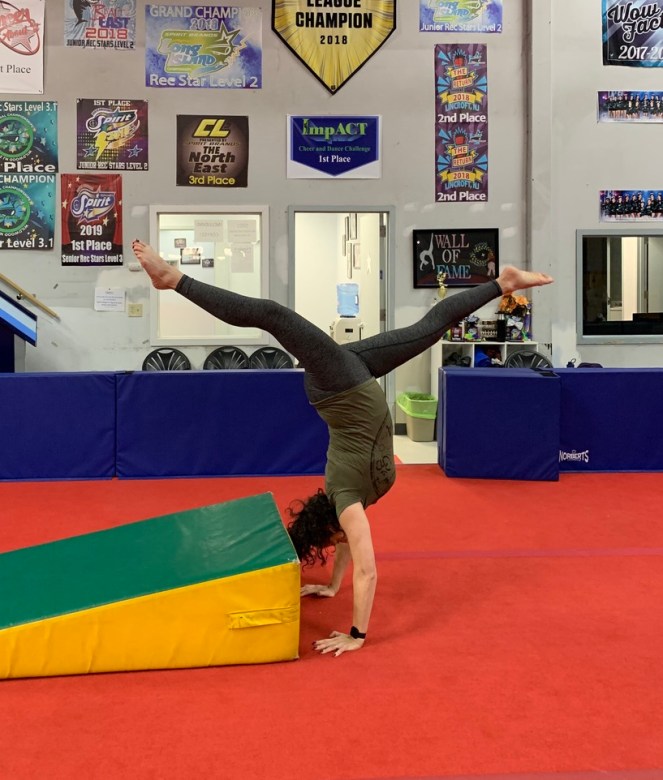
The obvious question is, “would I be having this pain if I did not do all this flipping and inverting?” I suppose that’s a good question for anyone doing more extreme fitness activities, but that question seems to loom larger when you consider my age.
We always say “age is just a number.” That is true, and the aging process presents challenges that the younger set just doesn’t have to think about. They heal quicker when they get hurt. Their bones are in a constantly regenerating cycle. In our 50s, the opposite is true, and the only way to fight osteoclastic activity is through regular strength training, walking and running. In my world, gymnastics is at the top of the list.
Look at my GG Chapter 4: Keeping the Bones Strong for more information about this.
Over the years, I’ve had my share of injuries. When I was young, it was my knees and hips from being a dancer. As an adult, it’s been more focused on my hips, back and shoulders. Yes, once in a while I have a bad landing or unfortunate mishap at the gym, but I’ve generally had the good sense to pull back, get things checked out, rehab as needed, heal and move on. Sometimes I have to stay away from certain skills or gym stations to do so.
I had a significant hip issue during the fall of 2020 while I was teaching dance to a screen of avatars on the carpeted concrete floor in my basement. That pain lasted a very long time, but eventually abated. I also had an unfortunately bad landing (also in chapter 4) that required significant down time. A right rotator cuff injury (gymnastics related) was successfully rehabbed in PT over several months’ time. It worked, and I’ve kept that at bay, only to start feeling my left shoulder in the last month.
In addition, my lower back has been talking to me for years. I take glucosamine/chondroitin/MSM every day, as well as magnesium, vitamin D and a host of other supplements. I figured, if I can help my body even a little bit from the inside, it would be smart. I even started getting medical massage therapy almost two years ago because I thought it was my aching muscles and joints reacting to everything I’ve been doing. I’ve dabbled in acupuncture, but I have not been impressed with the results.
My back issue, despite the weekly massage therapy, has not abated. It is a very specific spot, it doesn’t move or radiate, and shows up intermittently, especially when I try to hyperextend (back bend) or I move after sitting for a long time. My back-bending mobility is very limited and it certainly has affected things like handsprings (back and front). I was certain that the back issue led to the shoulder issue, and after recently being seen by a new PT, we decided it was time to get some imaging of the areas to see what was really going on. I’ve been advised that once you have an issue for more than 3 months, it’s time to get some pictures. This has been going on for years. I’m a little late to the party.
I got the imaging done; my first MRI experience. It wasn’t as bad as I had heard from others’ experiences. I was able to focus on my breathing and count the cycles of the incessant banging in the machine.

I didn’t know what the report would show, but I knew I needed to know the specifics. In my next visit to the PT, they interpreted the results. They certainly look scary. 😳
BACK:
- L1-2 and L2-3, disc bulge without focal disc herniation, significant central canal or neural foraminal stenosis
- L3-4, disc bulge with central stenosis. Bulge and facet hypertrophy cause bilateral foraminal stenosis
- L4-5, central disc herniation with annular tear causing effacement of ventral thecal sac and central canal stenosis. Bulge and facet hypertrophy cause moderate bilateral foraminal stenosis
- L5-S1, the disc appears somewhat rudimentary suggesting transitional lumbosacral anatomy. There is disc bulge with out focal herniation, no significant central or foraminal stenosis.
SHOULDER:
- Moderate rotator cuff tendinosis/strain and subacromial subdeltoid bursitis
- High grade partial thickness tear distal supraspinatus measuring 15x17mm
- SLAP tear with extension to involve the long head biceps tendon anchor
- Mild changes of acromioclavicular osteoarthritis with edema and spurring
- Subacromial spur
That is a giant mess: disc herniation, bone spurring, tears, osteoarthritis, bursitis. I suppose I’ve been feeling not-so-great things in my body for so long, but I’ve wanted to keep my activity level high, so any mild pain I might feel plays in the background. It’s when things start yelling at me that I pull back and slow things down; perhaps I needed to listen and act sooner. I guess the pictures are the proof that I need to take some corrective action now.
The good news: it is now summer, I am not working, and it is a good time to focus on these problems. I have no intent to stop flipping all together, but I also want to keep my body in the best shape I can so I can keep going to the gym as I get older.
The plan (so far)
Step 1: Anti-inflammatory injection with stem cells in my back to help calm things down. (DONE.) This will hopefully give me a few weeks with less pain so I can figure out the surgical issues.
Step 2: Decompression surgery to repair the herniation. When the herniated disc is filled in and stitched (as was explained by my medical team), it should help alleviate the other bulging discs. Then, I need to recover from that with PT.
Step 3: Another surgery to clean up the shoulder. Get rid of the bone spurring, which is likely causing or making the tears worse, and then continue PT to strengthen and mobilize the joint.
As far as working out is concerned, I definitely have to pull back the intensity. For now, low impact exercise (no running, which is fine with me) and no weight-bearing activity over my head. Shoulder mobility exercises are good, as well as walking, light trampoline and swimming. I’ll stay away from vaulting and tumbling on the floor and TumblTrak for now. It’s a bummer, but I want to stay in the gym for the long haul. I have to go into healing mode, which is a process.
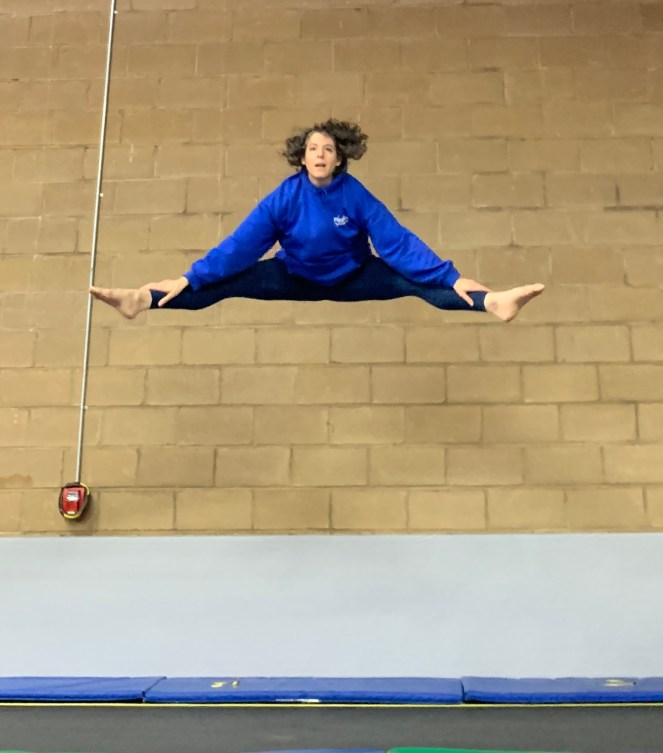
I guess it’s time to go back to basics: front and back tucks on trampoline, more lower body conditioning and mobility work.
No handstands, cartwheels, roundoffs or handsprings 😩. The bottom line is I have to be smart. I am injured, there’s no doubt about it, and I have pictures to prove it. Returning to full power (or as close as I can get to it), means I have to heal first. I’ve done it before and I’m sure I’ll do it again. I will try not to whine about it (no promises), but I definitely need a mental shift right now into recovery mode. It’s my body telling me to take a little vacation, get a little tune-up done, and I’ll be back in business soon enough.
Thank you for reading and watching my Geriatric Gymnastics stuff. Part of me shares it to document where I am, and part of me hopes to connect to others who share my interests. Feel free to comment and share this with anyone who might enjoy the read.

Check out my YouTube channel @thegeriatricgymnast, my Instagram @staceywritesandflips or my TikTok @staceytirro for the latest videos and Geriatric Gymnastics insights!

 Stacey's Headspace
You’ve been suffering with these injuries for quite a while and now is
the time to take care of them. Whatever you have to do to rectify the
problems you will do. It isn’t easy but you can handle it. Last
September I was diagnosed with bursitis in the right shoulder that I’m
sure I injured while exercising.I got a shot that alleviated it until
last month. Had another shot but it hasn’t done much to abate the pain.
See the doctor again next week and hope we can take care of this with PT.
Iris
LikeLiked by 1 person