

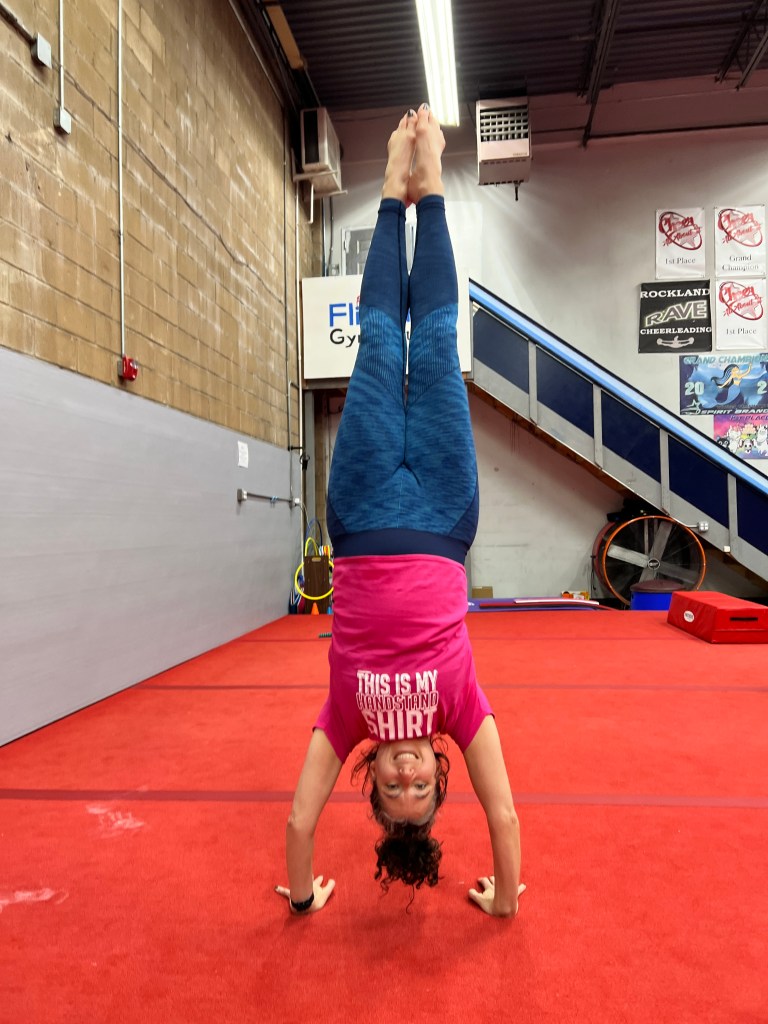
This post looks at the problems with and antidote to an over-training mindset. Especially as adults, we must practice our flippy habits with a wise mind so we can pursue longevity in gymnastics.
Published: February 2023. Revised: June 2025
Progress isn’t linear is one of my favorite sayings. It applies to everyone in everything we strive for. I have had to lean into it hard in my time as a Geriatric Gymnast.
So many times, I have enjoyed the glory of achieving a skill, even mastering it. Then, I hit a road bump that stagnates the progress. It could be anything: an injury, a change of season, being tired or feeling weak during any given session. Suddenly, you miss the skill. And you miss it again. For some reason, it’s no longer easily attainable.
This is a frustrating norm of all gymnasts. It can throw your whole understanding of progress into the gutter. Skills that I had taken for granted are suddenly downgraded. Out of the blue, my Lizard Brain deems it unsafe and subject to vehement censoring.
Sometimes, you get it
Case in point: the back hip circle.
After months of unsuccessful attempts, I finally made it around the bar. It wasn’t necessarily pretty, but the basics were there. Over time, I was getting more regularly consistent. I thought, It’s now a skill I’ve got. I can call upon any day! (Ha.)
Once you figure out the mechanics of a skill, the next phase is trying to fine tune and perfect it.
Sometimes, you don’t
One day, I was trying to improve my back hip circle technique. I tried to focus on hollowing out, keeping my arms straight, and making it smoother and prettier. Sadly, working on all of those things at once it scrambled something in my brain. Instead of improving, it got worse. Much worse. I started throwing my head back, and nearly gave myself a combination of whiplash and a shaken-head concussion.
That’s when Mr. Lizard Brain woke up and made subsequent attempts a big problem. It was at that point that I need to go back to square one. Step back, regroup, and approach the back hip circle like it is still a skill I have yet to acquire.
Sigh… The back hip circle is still one of those skills that I have a love-hate relationship with. The struggle is real.
This video is a example of more is not always better:
Fortunately, I have pretty good humor about failure. I’ve moved away from beating myself up when it doesn’t click. After a few attempts, if it’s not connecting, I’ve developed a different way to manage my training.
Managing our training approach
I have come to terms with this on-again-off-again situation (mostly). I have had to learn how to manage my overly eager penchant for quick skills acquisition. That mindset shift has been a hard-fought battle.
The problem with over-training failure
It’s been a hard transition. There was something exciting about the “keep trying until you get it” mentality. As long as I had the energy, I could keep pushing through the failed attempts. But, there is a problem with that mentality. It is really counterproductive to progress, and often looks like this:
- Over-training, especially with poor form and technique, reinforces subsequent failure.
- Repeating the same failures without changing form or technique is the formula for stagnation and continued setbacks.
- Repeated failures due to poor form or technique often leads to injury.
Over the years, I’ve had many encounters with failure, setback and injury. I’ve learned the hard way that if I continuously push a skill too hard, it will mess up everything. Staying healthy and intact means there’s always going to be next class to try again with a clearer head. I’d rather walk away a little frustrated than limping and devastated.
The antidote to over-training
The hard thing is taking wiser path. What does that mean? It means we sometimes have to step back and re-evaluate our failures.
How do we figure out what we are missing? By doing careful analysis.
- Get eyes on your technique: Have a trusted coach or gymnast friend help you to analyze your form. Also, taking video is an invaluable tool. You can easily slow it down and see where the root of your problems lie.
- Look at your movement patterns: Analyzing the patterns you are reinforcing that lead to the failures is important. Doing that work can lead you to the key to making corrective change.
- Go back to the fundamentals: Regularly revisiting the fundamentals and drilling some basics is the way to making corrections. Sometimes, it’s simple changes that make a huge difference: eye focus, adjusting your stance or engaging different muscle groups.
Commit to the Fundamentals covers the basics that everyone should be incorporating into our training habits. These are the gymnastics non-negotiables.
Coaching wise mind
I often see people’s tendency to over-train when I’m coaching. Younger adults are particularly eager to get skills so they can match the abilities of others around them. They see others doing back flips, so they want to do back flips. They try and fail repeatedly, sometimes impulsively, and get so frustrated with themselves.
It’s hard to witness people when they are so dug in. Sometimes they get It once, then fail every other time. They keep trying to “get it” over and over, hoping it will click on the next attempt. They can’t embrace the idea that incessant drilling of the wrong technique impedes their progress. Unfortunately, ego and impatience often gets in the way. This is when I remind them that progress is never linear and failure is part of the learning process.
The hardest part of coaching is convincing them to abandon their impulsive tendencies use their wise mind. Be patient, step back and revisit the basics when they start to backslide. These are all things that I keep telling myself every time I go to the gym. It’s certainly more useful self-talk than our anxiety brain chatter. We must replace the self-deprecating nonsense that so often runs on repeat in our minds.
The Geriatric Gymnast’s creed: Pursue longevity
What I always come back to, for myself and for anyone who I coach, is this. The most important thing in adult gymnastics is to be able to come back next week and keep training. Less is often more. The last thing any of us wants is to under-rotate, go askew and land on your head. No one needs that kind of stress.
To my extended adult gymnastics family: stay safe and have fun. Let’s make sure we can do this crazy obsession well into our older age.

 Stacey's Headspace
liked it.
LikeLike
Liked it.
LikeLiked by 1 person